4 Research-Based Benefits of Leadership Coaching
Last updated May 8, 2026

Coaching is the universal language of change & learning.
-CNN
A friend of mine recently asked me to explain coaching—why would someone hire a coach? Is this like doing yoga once a week? What's the point? Is it really worth the investment? These are the same questions many leaders ask before exploring coaching for themselves or their teams. If you're curious about the research-based benefits of leadership coaching, read on for what the studies actually show.
What is Leadership Coaching?
Leadership coaching is a personalized, one-on-one development partnership designed to help leaders strengthen their effectiveness, navigate complex challenges, and grow into their fullest potential. Unlike training or mentoring, leadership coaching is fundamentally client-driven—the leader sets the agenda, while the coach uses powerful questions, reflective space, and structured accountability to support meaningful growth. Research consistently demonstrates that leadership coaching produces measurable benefits, from greater confidence and clarity to improved communication, performance, and leadership capacity.

The Definition of Coaching
The International Coaching Federation (ICF) defines coaching as “partnering with clients in a thought-provoking and creative process that inspires them to maximize their personal and professional potential.” As a seasoned educator and leadership professor, I have found coaching to be one of the most powerful ways to achieve growth, skills learning, and goal achievement.
Coaching is essentially a one-on-one learning & development intervention that is:
✔️Client-driven: What’s on your agenda?
✔️Collaborative: What solutions can we co-create?
✔️Empowering: What vision do you want to see happen?
✔️Action-oriented: What is your next step?
There are different types of coaching, various approaches, and neighboring professions which overlap with similarities. Thus, confusion about coaching is common — how is coaching different from consulting or therapy? Each of these services provide powerful forms of help, but there are important differences:
Although the lines blur, consider these guidelines when deciding which help will meet your needs:
Find a mentor when you want someone who’s been there before you to show you the ropes.
Hire a consultant when you need an expert to diagnose a problem and propose an intervention.
Work with a therapist when you are struggling and need treatment for mental health challenges.
Seek a coach when you want a thought partner to help you meet specific goals for personal, professional, or leadership growth.
There are many different types of coaching, including, life, career, spiritual, relationship, productivity, business, leadership, and executive coaching. Many coaches have very defined niches, so you may be surprised to learn there is likely a coach who specializes in the unique need that you have.
Want to Bring Coaching Skills Into Your Leadership?
You don't have to hire a coach to bring coaching benefits into your leadership. 100 Coaching Questions for Leaders: A Complete Guide gives you 100 powerful questions organized across ten leadership categories, plus templates and a coachability assessment to help you take a coach approach with your team.
The Benefits of Coaching
Common times to seek a coach include during transitions, when faced with new opportunities or challenges, and when desiring greater personal or leadership growth. Before you invest in hiring a coach, you may need to be convinced there will be a return on your investment. If you are an executive leader or HR manager seeking to partner with internal or external coaches, you also need to be able to justify and demonstrate that the financial commitment is worth it.
Although coaching is a relatively new profession, several research studies demonstrate the positive outcomes clients can experience. Some of the most common benefits experienced by clients include:
confidence & clarity
relationship & communication skills
learning & performance
leadership development
If you're a leader who wants to bring these coaching benefits into your role, learn how to cultivate a coaching mindset to make coaching skills part of your everyday leadership.
#1 - Confidence & Clarity
One of the greatest values of coaching is the space it creates for gaining confidence and clarity. A study conducted by Leedham in 2005 described perspectives from over 220 coaching clients on the top-rated benefits of coaching. Clients in the study used the following terms to describe the positive outcomes:
confidence, feel good, believe in myself, positive feelings
clarity of purpose, clear goals, focus
awareness & insights, self-analysis, reflect to see the big picture
The good news is that increased confidence often co-occurs with greater effectiveness in skills or behaviors. Participants in a 2014 study by Gyllensten & Palmer explained how increasing their confidence through coaching led to better job performance (i.e. tackling challenges more assertively, solving problems creatively, applying knowledge with greater assurance) and specific advantages outside of work (i.e. not bringing work home, happier relationships at home, etc.).
#2 - Learning & Performance
Another key benefit of coaching is the opportunity it provides to tailor learning goals to each client. Whereas training or instructing efforts typically are packaged in a broader, one-size-fits-all approach, individual coaching is designed to support unique learning needs.
Research from a 2009 study conducted by Griffiths & Campbell led to the creation of a learning-centered theory of coaching, which demonstrates that learning happens through four overlapping processes unique to the coaching experience:
Relating - a trusting relationship sets the stage for learning
Questioning - asking powerful questions (from the coach) drives deep insights
Reflecting - active self-reflection (by the client) results in new discoveries
Listening - listening creates space to notice and acknowledge the learning that occurs
Coaching is intended to encourage the client in moving from awareness to action, so the most effective coaching will facilitate opportunities for clients to integrate the new insights they gain into relevant action steps. In a 2015 review of coaching research including 17 studies, Jones and colleagues noted that one of the greatest positive outcomes of coaching was the transfer of learning to performance.
#3 - Relationships & Communication Skills
A third benefit of coaching is the potential to strengthen both communication & relationships. In a 2006 study published by Garvey, 17 HR professionals from different organizations observed that executive leaders who were coached experienced improved relationships across all levels - with managers, directors, and subordinates. And in Leedham’s 2005 study, several coaching clients reported more effective personal relationships as a positive outcome of being coached.
Other studies demonstrate specific ways that leaders enhance their communication skills as a result of being coached. For example, Kombarakaran and colleagues reported that direct reports experienced the following from their managers who had been coached:
more positive feedback
increase in transparent communication
greater access to information
an improved feedback loop
#4 - Leadership Development
A study by Ladegard and Gjerde in 2014 demonstrated that leadership coaching can serve as a valuable leadership development tool in a few specific ways. Results from this study showed that through coaching, senior leaders: 1) increased their confidence to navigate opportunities and challenges in their specific leadership role (leadership self-efficacy), and 2) increased their trust in their direct reports (which often leads to other important benefits in the manager - employee relationship).
Other research has shown how coaching can support the development of transformational leadership (TL) practices (Cerni et al., 2010; MacKie, 2014), which translates to leaders who: demonstrate greater integrity; are more responsive to employee needs; are more likely to inspire, motivate, and effectively challenge their employees; and are skilled at cultivating safe spaces to learn, experiment, and question.
“I believe that wherever there is mastery, coaching is occurring and whenever coaching is done, mastery will be the outcome.”
From Research to Practice: Bringing Coaching Benefits to Your Team
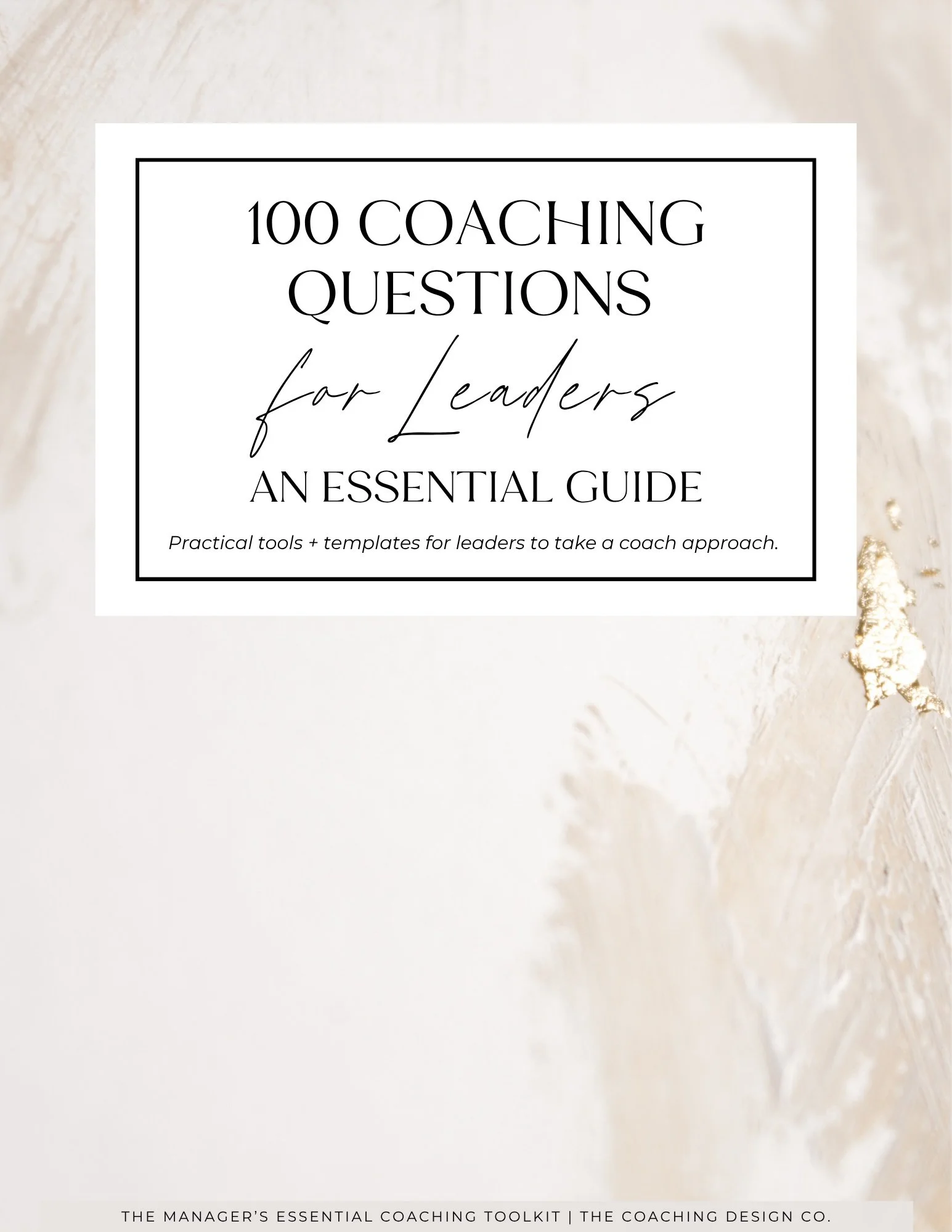
Transform Your Leadership Style with 100 Powerful Coaching Questions for Leaders
100 Powerful Coaching Questions for Leaders: Organized into 10 key leadership categories, these coaching questions will help you facilitate insightful conversations, encourage self-reflection, and drive positive change within your team. The categories include:
Self-Awareness: Foster deeper understanding and personal growth.
Productivity: Enhance efficiency and time management.
Decision-Making: Improve judgment and problem-solving skills.
Vision & Strategy: Align individual and team efforts with organizational goals.
Communication & Influence: Strengthen interpersonal skills and impact.
Mentoring & Development: Guide and support the growth of your team members.
Team Building: Cultivate collaboration and high-performing teams.
Managing Stress: Help individuals navigate challenges and maintain well-being.
Change Management: Support team members through transitions and new initiatives.
Managing Performance: Provide constructive feedback and drive improvement.
Essential Coaching Tips and Templates: Learn fundamental coaching skills and immediately implement ready-to-use templates for various coaching conversations.
Coachability Assessment: Understand your team members' readiness for coaching and tailor your approach. This assessment helps you identify where coaching will be most effective.
Goal-Setting Exercise for Leaders: Develop your own coaching goals and create a roadmap for integrating coaching into your leadership style.
10 Inspirational Quote Posters: Stay motivated with these inspirational quote posters designed to support your growth as a coaching leader.
Who is this toolkit for?
New leaders looking to build a strong foundation in leadership coaching skills.
Experienced leaders wanting to enhance their coaching abilities and adopt a more coach-like leadership style.
Managers transitioning into broader leadership roles who need a complete guide to coaching their teams.
HR professionals and leadership development trainers seeking valuable coaching resources for their programs.
Coaches who specialize in leadership coaching.
Anyone who believes in the power of employee development and fostering a growth mindset.
This is a digital download, formatted as a PDF file. No physical item will be shipped to you.
“This is a practical tool for leaders who want to grow in curiosity and connection with their team. The workbook is clear on its purpose, offering both direction on developing a coaching mindset and a practical path for applying coaching questions in leadership—whether in everyday conversations or specific situations. The 100 questions will fill your coaching toolbox, and the reflection work creates space to lead your team with authentic invitations to grow together. Best of all, it doesn't feel like one more thing on a full leadership plate—it feels like a tool that makes leadership easier.” — Tonia M., Program Manager
The research is clear: leadership coaching produces real, measurable benefits. But you don't have to hire an executive coach to bring these benefits into your leadership. By developing coaching skills and taking a coach approach with the people you lead, you can foster the same outcomes—confidence, clarity, learning, performance, and stronger relationships—within your own team.
100 Coaching Questions for Leaders: A Complete Guide is designed for exactly this. It's a practical workbook that gives you:
100 powerful coaching questions organized across ten leadership categories—from self-awareness and decision-making to team building and managing performance
Practical templates to structure your coaching conversations
A coachability assessment to help you tailor your approach
Reflection prompts to help you embody a coaching mindset every day
Whether you're a new leader building your coaching foundation or an experienced leader refining your approach, this guide is your companion for confidently leading impactful coaching conversations that drive real results—for both yourself and your team.
References
Cerni, T., Curtis, G. J., & Colmar, S. H. (2010). Executive coaching can enhance transformational leadership. International Coaching Psychology Review, 5(1), 81-85.
Dagley, G. (2006). Human resources professionals’ perceptions of executive coaching: Efficacy, benefits and return on investment. International Coaching Psychology Review, 1(2), 34-45.
Fischer, R. L., & Beimers, D. (2009). “Put me in, Coach”: A pilot evaluation of executive coaching in the nonprofit sector. Nonprofit Management and Leadership, 19(4), 507-522.
Griffiths, K., & Campbell, M. (2009). Discovering, applying and integrating: The process of learning in coaching. International Journal of Evidence Based Coaching and Mentoring, 7(2), 16-30.
Gyllensten, K., & Palmer, S. (2014). Increased employee confidence: A benefit of coaching. The Coaching Psychologist, 10(1), 36–39.
Jones, R. J., Woods, S. A., & Guillaume, Y. R. (2016). The effectiveness of workplace coaching: A meta‐analysis of learning and performance outcomes from coaching. Journal of Occupational and Organizational Psychology, 89(2), 249-277.
Kombarakaran, F. A., Yang, J. A., Baker, M. N., & Fernandes, P. B. (2008). Executive coaching: It works!. Consulting Psychology Journal: Practice and Research, 60(1), 78-90.
Ladegard, G., & Gjerde, S. (2014). Leadership coaching, leader role-efficacy, and trust in subordinates. A mixed methods study assessing leadership coaching as a leadership development tool. The Leadership Quarterly, 25(4), 631-646.
Leedham, M. (2005). The Coaching Scorecard: A holistic approach to evaluating the benefits of business coaching. International Journal of Evidence Based Coaching and Mentoring, 3, 30-44.
MacKie, D. (2014). The effectiveness of strength-based executive coaching in enhancing full range leadership development: A controlled study. Consulting Psychology Journal: Practice and Research, 66(2), 118.