Why Team Training Doesn't Always Create Lasting Team Development
“The strength of the team is each individual member. The strength of each member is the team.”
Your team sat through the training.
There were slides. A few good insights. Someone said "that really resonated," and everyone filled out the worksheet with genuine effort. It felt like a productive use of a morning.
Then a few weeks passed.
The same communication breakdowns were waiting.
The same frustrations between two colleagues who never quite say what they mean.
The same decisions that stall because no one's sure who owns them.
Whatever shifted during the session seemed to settle back into place by the next busy stretch.
If this sounds familiar, I want to offer you some reassurance: you are not bad at team training. You've simply been asking a single session to do the work of an ongoing process. Those are two very different things, and the gap between them is where a lot of well-intentioned time and budget subtly disappear.

QUICK GUT CHECKWhen was the last time your team completed a training, and can you name one thing about how they work together that permanently changed because of it? If the answer comes easily, wonderful. If it doesn't, keep reading.The Difference Between Team Training and Team Development
Let's define the two, because the words get used interchangeably and that's part of the problem.
Team training is typically an event. A focused session designed to deliver information, introduce a framework, or teach a specific skill. Think a half-day workshop on communication styles, an assessment debrief, a facilitated session on giving feedback. These have real value. They build shared language, surface useful insights, and give a team a common starting point.
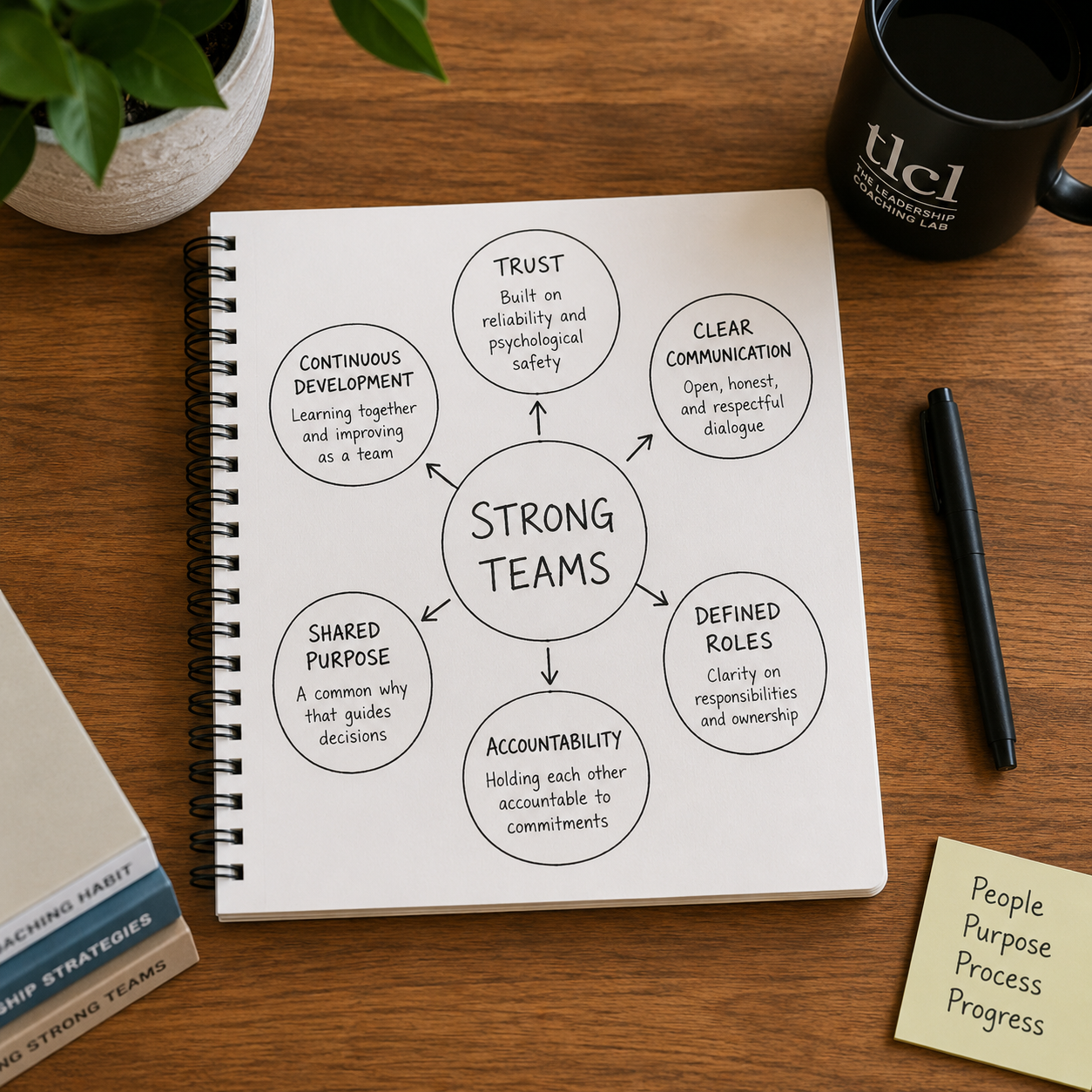
Team development is a process. It's the intentional, ongoing work of turning those insights into changed behavior — building the skills, trust, and shared understanding that reshape how a team actually operates day to day. It addresses how people communicate, how decisions get made, how conflict gets handled, and how individual strengths get aligned to the work.
Here's the distinction in one sentence: team training delivers the insight; team development makes the insight stick. You need both. But when a single training is expected to deliver the results of the deeper work, disappointment is almost guaranteed.
Why the Training Alone Rarely Sticks
There's a reason the post-training clarity fades, and it isn't about the quality of the session. It's about how change actually works.
Research on learning and development has a well-documented challenge often called the transfer problem: the gap between what people absorb in a session and what they carry back into daily work. Studies of workplace training consistently find that a large share of what's taught is never applied on the job. Insight gained in one setting does not automatically travel into another. Without deliberate reinforcement, most of what we learn in a one-time session simply fades.
Team training runs headfirst into this problem for a few specific reasons:
The session isn't connected to the real work. A framework taught in the abstract is interesting, but it rarely maps onto the actual friction points a team faces. People can nod along to a model of healthy conflict in the morning and walk right back into the same avoidance around a real project that afternoon, because the pattern was named in theory but never worked through in practice.
There's no follow-through. A single session, however good, is a moment. Lasting change needs repetition and reflection. When there's no structure to revisit what was learned, apply it, and adjust, the insight has nowhere to take root.
It skips the harder conversations. Genuine team development often requires surfacing things that are uncomfortable: an absence of trust, unspoken assumptions, a pattern of avoiding conflict. As Patrick Lencioni puts it, "trust is knowing that when a team member does push you, they're doing it because they care about the team." A training designed mainly to deliver content can quietly step around exactly the tensions that most need attention.
It treats symptoms, not causes. Low morale, poor communication, and stalled creativity are usually signals of something structural — misaligned roles, unclear expectations, a lack of psychological safety. A well-run training can raise awareness for a day. It cannot resolve the root cause it was never designed to touch.
Pause and consider: What is the actual pattern slowing your team down right now? Not the symptom you notice, but the thing underneath it. If you can't quite name it yet, that clarity is itself the first piece of development work.
What Actually Creates Lasting Team Development
So if a single training isn't enough, what does move the needle? In my experience facilitating teams over the past two decades, lasting development shares a few ingredients.
It starts with real understanding, not a generic curriculum. Before you can develop a team, you have to understand how it actually works — where the strengths are, where the friction lives, what each person brings and what drains them. This is why I lean on research-backed assessments like Working Genius, CliftonStrengths, the Enneagram, and MBTI. Used well, they give a team a shared language for dynamics that were previously invisible or unspoken.
It connects insight to the daily work. An assessment result printed and filed away changes nothing. The value comes from facilitation — the guided work of taking those insights and translating them into how the team assigns roles, runs meetings, makes decisions, and handles disagreement. This is the step that gets skipped most often, and it's the step that makes everything else matter.
It builds in over time. Development that sticks is rarely a single session. It's a series of touchpoints that build on each other, so the team has room to practice, reflect, and refine. Growth doesn't stop when the training ends; ideally, that's when it starts.
It develops the people who lead the team. Some of the most durable change happens when managers themselves learn practical coaching skills they can use in everyday conversations. When the leader can coach, development continues long after any outside facilitator is gone. That's the difference between renting a result and building the capacity to create it yourself.

A Better Way to Think About the Investment
None of this means training has no place. A strong session can be exactly the right starting point — it builds shared language and gets everyone on the same page. I'd never argue against a team learning something valuable together.
The shift I'd invite you to make is one of expectation. Book the standalone training to introduce a framework and build shared understanding. Invest in facilitated team development when you want to change how the team actually works. Confusing the two is what leads to the deflating few-weeks-later feeling — and to the conclusion that "team training doesn't work," when the truth is it was simply the wrong tool for the goal.
The teams that grow the most are the ones that stop looking for a single session to fix a structural challenge, and start treating their development as an intentional, ongoing practice. That's slower than a one-day training. It's also the only thing that lasts.
If your team has talent but not traction — if they've taken the assessments but nothing changed, or a transition has disrupted the dynamic — that's precisely the work I do. My team facilitation and workshops are never pre-packaged. I study your team, choose the frameworks that fit, and design sessions built to stick, so growth continues long after our time together.
FAQs
-
Team training is usually a one-time session designed to deliver information, teach a skill, or introduce a framework, like a communication workshop or an assessment debrief. Team development is an ongoing, intentional process that turns those insights into changed behavior— building the skills, trust, and shared understanding that reshape how a team works day today. Team training delivers the insight; team development makes it stick. Most teams benefit from both, but problems arise when a single training is expected to produce lasting change.
-
Training alone rarely sticks because of what's known as the transfer problem — insight absorbed in a one-time session doesn't automatically carry into daily work without reinforcement. Studies of workplace training consistently find that much of what's taught is never applied on the job. Team training is often disconnected from a team's real challenges, lacks structured follow-through, avoids the harder conversations that development requires, and addresses surface symptoms rather than root causes like misaligned roles or a lack of trust.
-
No. Team training has genuine value for building shared language, introducing frameworks, and getting a team on the same page. The key is matching the tool to the goal: use a standalone training to build understanding, and invest in facilitated team development when you want to change how the team actually operates. The disappointment comes from expecting a single session to do the work of a process.
-
Lasting team development starts with genuinely understanding how a team works, often through research-backed assessments like Working Genius or CliftonStrengths. It then connects those insights to daily work through facilitation, builds over multiple touchpoints rather than a single session, and often includes developing the leader's own coaching skills so growth continues long after an outside facilitator is gone.
-
A standalone training can be a strong starting point, but development that lasts usually involves a series of connected sessions that build on each other, giving the team room to practice and refine new ways of working. Effective facilitation also translates insights into concrete changes in how the team assigns roles, runs meetings, and handles conflict — the step that's most often skipped.
Ready to move from a good session to a better team?
If you're tired of investing in team training that fades within weeks, let's build something that lasts.
I design custom team development workshops and facilitation around your team's actual strengths and challenges — not a pre-packaged agenda, but a process built to create real, lasting change in how your people work together.
Schedule a free consultation and let's talk about what your team actually needs.

Dr. Bethany Peters is a Professional Certified Coach (PCC) and leadership expert who helps individuals, teams, and organizations grow through leadership coaching, executive development, team facilitation, and evidence-based assessments. Whether she's coaching one-on-one or leading a workshop, Bethany creates practical, engaging experiences that help people communicate better, lead with confidence, and create lasting change.