How LEGO® Serious Play® Can Deepen Leadership Development
“Learning is the process whereby knowledge is created through the transformation of experience.”
Traditional leadership development relies heavily on words.
We listen to presentations. Talk with coaches. Discuss case studies. Write reflection responses. Give and receive feedback.
And there is good reason for that. Conversation, reflection, and collaboration are essential to development.
But what happens when a leader is trying to understand something they don't quite have words for yet?
How would you describe the leader you're becoming?
What does the pressure you're experiencing actually look like?
Where are you getting in your own way?
What competing priorities are you trying to hold at the same time?
What does your team need from you in this particular season?
These aren't questions with quick answers. And sometimes asking a leader to simply talk about it keeps the conversation in familiar territory.
That's one reason I've become interested in using LEGO® Serious Play® in leadership development.
LEGO® Serious Play® is a structured facilitation methodology in which participants build models in response to carefully designed questions, assign meaning to what they've built, share the story of their model, and reflect on what they notice. The methodology draws on ideas from constructionism: the idea that learning can be particularly powerful when people are actively engaged in making something they can think with, examine, and share.
And if you're wondering, What does LEGO® have to do with leadership? That's exactly what I want to explore here. The method can give leaders a tangible way to explore questions that are difficult to answer through conversation alone. Building and explaining a model can help leaders make their thinking visible, interpret insights, examine complex relationships, and experiment with new possibilities before deciding what to do differently.
A QUICK CHECK-INThink about the last leadership-development experience that genuinely changed how you lead.
1. What made the difference?
2. What was most memorable?
3. What created a shift in your thinking or deepened your understanding?What Actually Happens in LEGO® Serious Play®?
If your mental image is a room full of leaders being handed LEGO® bricks and told to “be creative,” that's not quite it.
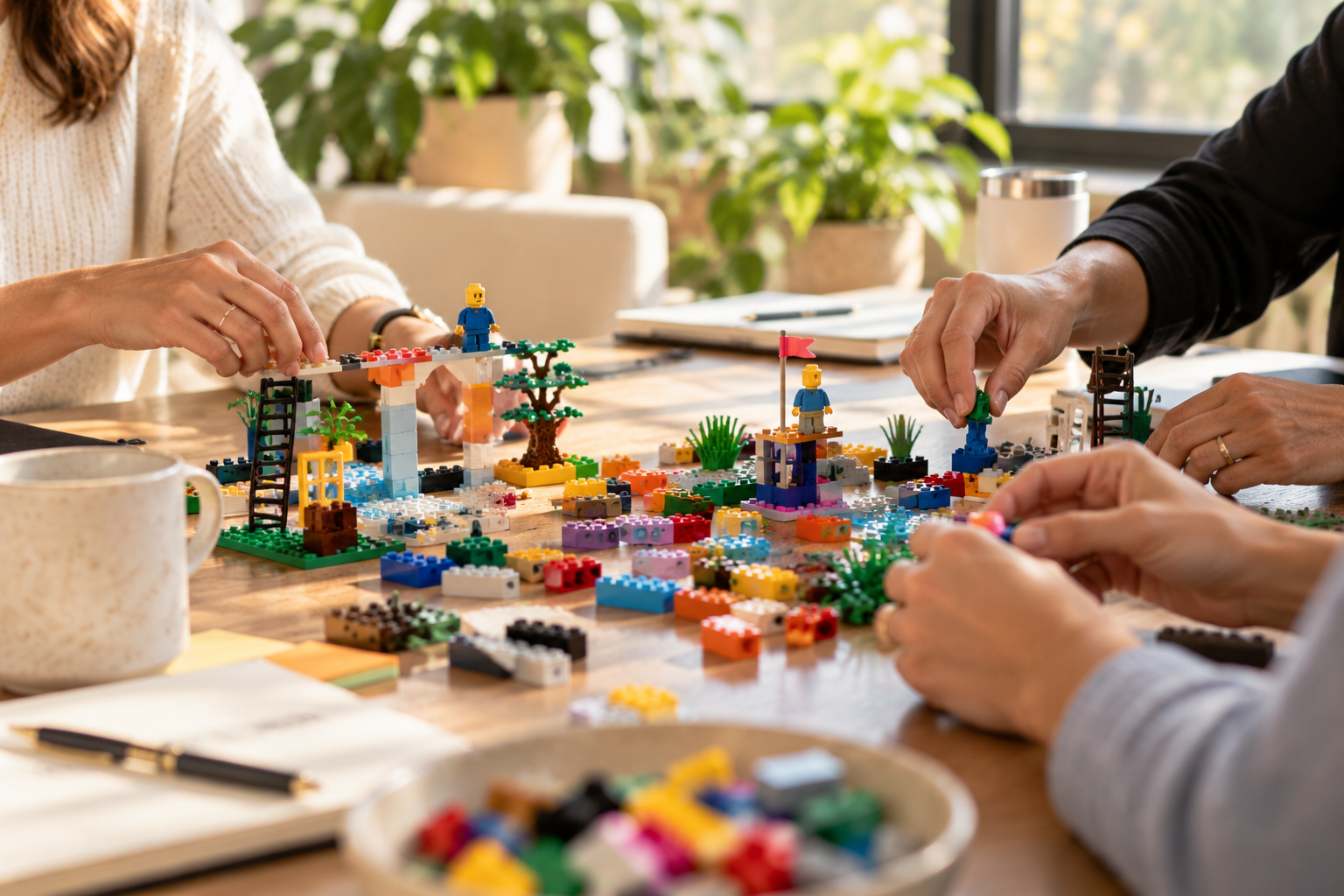
LEGO® Serious Play® follows a structured facilitated process. A facilitator poses a carefully designed question. Participants build individual three-dimensional models in response, give meaning to the elements they've built, share the story of their model, and reflect on what has emerged.
Researchers commonly describe the core process as:
challenge → build → share → reflect
And studies of the methodology have explored how this combination of making, metaphor, storytelling, and reflection can support deeper learning.
The bricks are the medium for a more tactile, memorable reflection process:
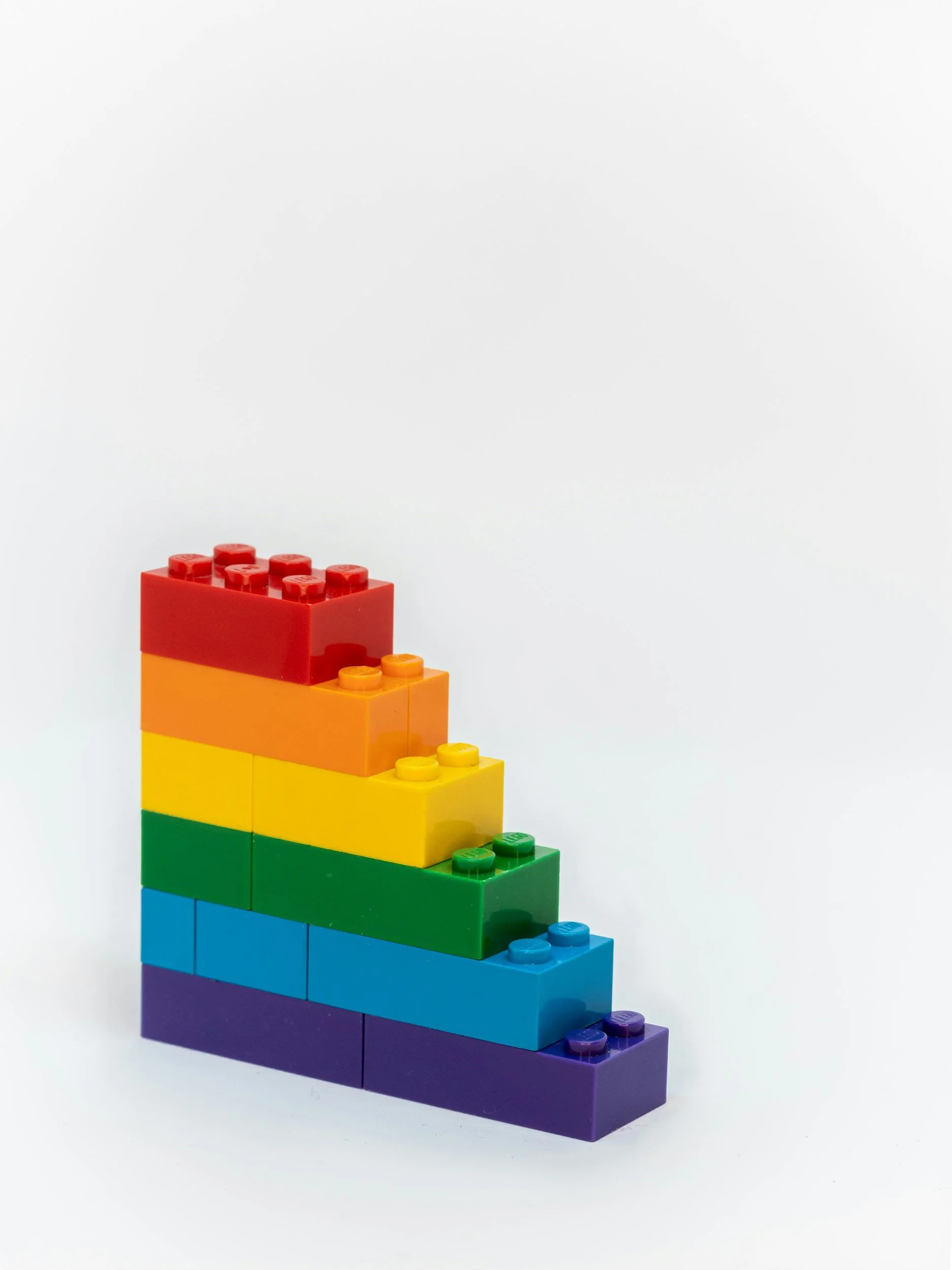
A red brick might represent pressure.
A wall might represent a boundary—or an obstacle.
A bridge might represent connection.
A figure standing alone might represent independence to one leader and isolation to another.
Importantly, the facilitator doesn't interpret the model for the leader. The person who built it determines what it means. The model then becomes something you can use to articulate your own thinking, examine it from another angle, and have a different kind of conversation about it.
If you're new to the methodology, you can learn more about how I use LEGO® Serious Play® facilitation with leaders, teams, and organizations.
So why might this matter for leadership development?
1. Building Can Make Abstract Leadership Questions More Concrete
Leadership is full of abstract concepts.
Trust, influence, identity, purpose, culture, change, alignment, confidence, belonging.
We can—and should—talk about them. But asking someone to represent an abstract idea physically creates a different task.
Consider the question: What does leadership look like when you're at your best?
You could answer that verbally. Or you could build it.
Perhaps you place yourself at the center of your model. Or, surprisingly, you don't include yourself at all. Maybe you build several connections between people. Maybe everything is supported by one precarious structure. Maybe there's a wall. Maybe one piece suddenly feels more important than you expected it to.
Now there's something to examine.
This isn't just a theoretical possibility. In a study specifically examining the use of LEGO® Serious Play® with graduate leadership students, Mary Anne Peabody and Elizabeth Turesky found that participants described greater visual clarity around leadership concepts, opportunities to experience group dynamics in real time, and meaning-making through metaphorical storytelling. One participant specifically described moving beyond simply knowing their strengths to seeing how those strengths could be articulated and applied within group dynamics.
That's particularly interesting for leadership development because sometimes a leader doesn't need another concept.
They need a way to concretely articulate their own thinking.
2. The Model Creates Something to Reflect On
Reflection is already a well-established part of leadership development.
But there is a subtle difference between asking, What did you learn about yourself? and putting something you've created in front of you and asking, What do you notice?
Once an idea exists outside of your head as a physical model, there is something concrete to question.
What's most important here?
What's taking up more space than you expected?
What's missing?
What seems disconnected?
What would you change?
That idea has been explored in research on LEGO® Serious Play® and reflective practice. In a qualitative study of graduate students and faculty, Peabody and Noyes examined an adaptation of the methodology as a reflective-practice pedagogy. Participants reported outcomes including deeper meaning-making and the development of language for emotional content.
And that leads to what I think may be one of the most interesting uses of LEGO® Serious Play® in leadership development.
3. Metaphor Can Give Leaders Language for Things That Are Hard to Name
There's another reason the bricks matter: they invite metaphor.
A leader builds a bridge, a wall, a tower, a tangled collection of pieces, a person surrounded by other people, or a person standing very far away.
Then the facilitator asks, Tell me about this.
The meaning belongs to the builder, but the metaphor gives them something even more thought-provoking to work with.
Metaphorical storytelling isn't incidental to LEGO® Serious Play®. Research on the methodology describes participants building symbolic or metaphorical representations in response to facilitator questions and then using stories to connect those representations to their thoughts, experiences, challenges, and possible resolutions.
I think this becomes especially useful when the leadership question is complex or emotionally layered. “I need to delegate more” is one kind of familiar statement. I've built myself holding up the entire structure” provides a more vivid metaphor that may stick with you longer.
Follow-up facilitation questions might include:
Why are you holding the entire structure?
What would happen if you stopped?
Who else could carry some of the weight?
What are you afraid would happen to the structure?
The metaphor hasn't diagnosed the problem. It has created a richer language for exploring it.
4. Building Lets Complexity Stay Complex for a Little Longer
This may be one of the things I appreciate most about the method. Leadership development can sometimes move too quickly toward resolution: identify the problem, name the goal, choose the action, make the plan.
There is certainly a time for all of those things. But leadership challenges are often systems problems before they're action-item problems.
A leader may be simultaneously navigating a difficult employee, pressure from above, organizational change, limited resources, their own values, competing priorities, and a team that's tired. If we immediately ask, What's the action step?, we may be asking the leader to solve something they haven't fully understood yet.
A three-dimensional model can hold several parts of the situation at once. People, barriers, relationships, forces, competing priorities, and uncertainties can all exist in the same physical space.
Seeing that complexity in a model allows us to spend a little longer asking: What's actually happening here?
What influences what?
Where is the tension?
What have you left out?
What are you trying to protect?
What changes if one part of the system moves?
The methodology itself was originally developed in a business context and has been used to represent challenges, complex systems, and potential resolutions through metaphorical models. Its usefulness here isn't that a LEGO model perfectly captures the complexity of organizational life. It's that the model gives a leader another way to represent relationships among parts of a challenge and then examine them.
Before deciding what to do, the leader gets an opportunity to develop a richer understanding of what they're actually dealing with.
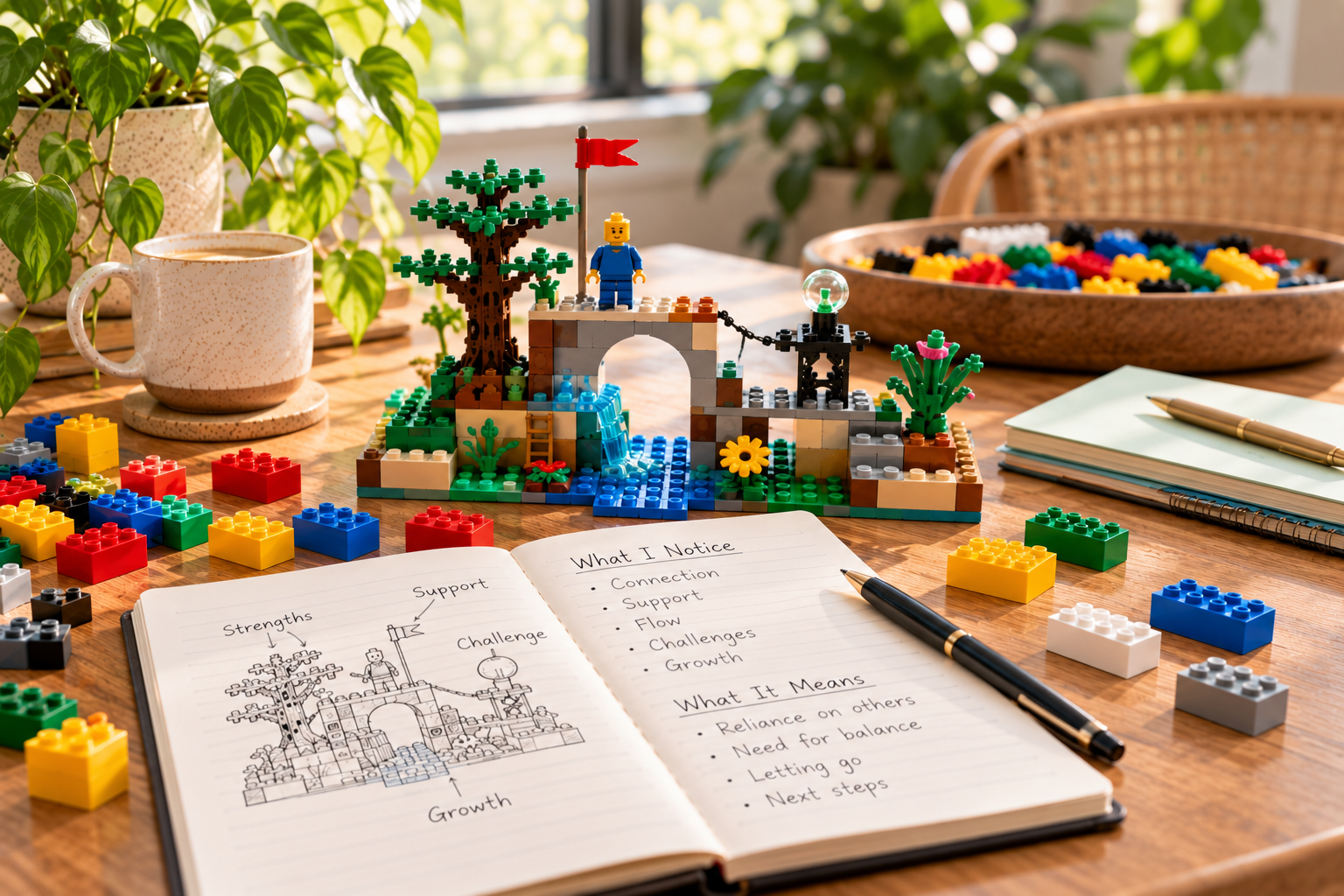
5. The Model Becomes a Place to Experiment
The first model doesn't have to be the final model.
Imagine a leader builds their current team environment. They can see the bottleneck, where they are positioned, and the distance between two parts of the team.
Now we can ask: What would you change?
They might move something, add something, take something away, create a connection, or change their own position.
Then they can look again.
What's different? What became possible? What new problem did the change create?
This is one reason I think LEGO® Serious Play® can move beyond creative reflection. The model can become a low-risk space for experimentation.
The leader isn't yet restructuring the team or having the difficult conversation. They're manipulating a representation of the situation, considering alternatives, and thinking through possible consequences.
Experimentation itself is a leadership capability. Leaders rarely operate in situations where there is one obvious solution and complete information. They need to generate possibilities, test assumptions, notice consequences, adjust their thinking, and try again.
A physical model gives them a small-scale way to practice that process.
What if I moved this? What if I changed my own position? What if this person had more influence? What happens elsewhere in the system if I make that change?
Instead of moving directly from insight to a single action plan, the leader can explore several possible responses before deciding what to try in the real world.
That creates a useful bridge between reflection and action, and it brings us back to Kolb's experiential-learning framework.
Experiential learning isn't simply about having an experience. It involves transforming experience through reflection, conceptualization, and active experimentation. Research on LEGO® Serious Play® in leadership education situates the methodology within this experiential-learning tradition.
For leadership development, that's an important distinction. The goal isn't simply to leave with an insight.
It's to become better at thinking, experimenting, learning, and adapting as you lead.
6. Building Can Strengthen a Leader's Own Critical Thinking
There's one more benefit that's easy to overlook. When a leader builds a model, the type of conversation we’re having changes.
Instead of the facilitator or coach being the person with the answers, the model sits between you. The facilitator can ask:
Tell me about this piece. What does this connection mean? What's happening over here? If you could change one thing in this model, what would it be?
The leader remains the expert on the meaning of what they've built. Research descriptions of the methodology reinforce this principle: questions are directed toward the model, and participants explain their own stories and representations rather than having someone else assign meaning to them.
I think this matters for leadership development beyond the immediate insight that might emerge from a particular model. We're giving leaders practice thinking critically about their own leadership. They have to examine what they've created, question their assumptions, make connections, explain their reasoning, and consider what they may be missing.
That's a very different developmental posture from waiting for a facilitator, coach, or assessment report to tell you what something means.
That makes LEGO® Serious Play® especially compatible, in my view, with a coaching approach to leadership development. Good coaching isn't about interpreting someone's experience for them. It's about creating the conditions for them to examine their own thinking more clearly.
The questions, the building, the explanation, and the reflection involved in LEGO® Serious Play® create conditions in which insight can emerge — and, perhaps just as importantly, give leaders practice doing the kind of critical thinking they'll need when the facilitator is no longer in the room.
What Might Leaders Explore Through LEGO® Serious Play®?
There isn't one prescribed “leadership build.” The questions should follow the developmental purpose.
Leaders might explore:
Leadership identity: What kind of leader am I becoming?
Strengths: What does this strength look like when I'm using it well—and when I'm overusing it?
Values: What matters most in the way I want to lead?
Current challenges: What's really happening in this situation?
Stakeholder relationships: Who influences this system, and how?
Change: What am I being asked to let go of, preserve, or create?
Team leadership: What does my team need from me right now?
Future leadership: What would leadership at my next level require from me?
Barriers: What's getting in the way of the leader I want to be?
Experimentation: If I changed one thing, what might become possible?
The questions matter enormously.
Handing someone bricks doesn't automatically produce deep reflection any more than handing someone a journal automatically produces meaningful insight.
The quality of the developmental experience depends on the quality of the questions, the facilitation, and what happens with the insight afterward.
Frequently Asked Questions
-
LEGO® Serious Play® can help leaders explore abstract or complex developmental questions by building three-dimensional models in response to carefully designed prompts. Leaders explain the meaning of their models, reflect on what they notice, and can change the models to explore different possibilities. The methodology can be used to examine leadership identity, strengths, values, relationships, change, current challenges, and future leadership.
-
What leaders learn depends on the questions being explored. The method can help leaders make their thinking visible, identify patterns and relationships, interpret feedback or assessment insights, explore competing priorities, and consider how they might approach a situation differently. The facilitator doesn't interpret the model; the leader gives meaning to what they have built.
-
LEGO® Serious Play® draws on theories of learning including constructionism and experiential learning, and a growing body of research has examined its use in reflection, leadership and management education, collaborative learning, and meaning-making. Research involving graduate leadership students, for example, has explored how metaphorical three-dimensional building can support visual clarity around leadership concepts, storytelling, and awareness of group dynamics.
-
Yes. In fact, this is one of the applications I find particularly interesting. LEGO® Serious Play® can help leaders move beyond simply understanding an assessment result to exploring what it means in practice. A leader might build what a particular strength looks like when it's serving their leadership well, for example, and then modify the model to explore what happens when that strength is overused. The assessment provides insight; building creates another way to interpret and apply it.
-
No. Although LEGO® Serious Play® is frequently used with teams and groups, it can also be used to explore individual leadership-development questions. A leadership workshop might combine individual builds with group reflection, or the methodology can be incorporated into a broader coaching or leadership-development experience.
-
LEGO® Serious Play® can be particularly useful for leadership questions that are complex, abstract, relational, or difficult to articulate. Examples include leadership identity, navigating change, stakeholder relationships, competing priorities, delegation, team dynamics, strengths, barriers to effectiveness, and envisioning a different future.
Build a Different Kind of Leadership Development Experience
The most useful leadership-development experiences don't simply give leaders more information about leadership.
They help leaders see themselves and their challenges differently—and decide what to do with what they discover.
That's where I find LEGO® Serious Play® especially powerful.
My work brings together leadership development, executive coaching, learning design, and LEGO® Serious Play® facilitation.
I always begin with the leadership question:
What do your leaders need to understand, explore, or do differently?
Then we design the experience around it.
Whether you're creating a leadership program, planning a retreat, developing a leadership team, or looking for a more meaningful way to work with assessment insights, LEGO® Serious Play® can create a different kind of space for leaders to think, reflect, and experiment.
Or schedule a free consultation and tell me a little about your leadership development needs. We can talk through what's happening, what you'd like to accomplish, and which approach might be the best fit.

Dr. Bethany Peters is a Professional Certified Coach (PCC) and leadership expert who helps individuals, teams, and organizations grow through leadership coaching, executive development, team facilitation, and evidence-based assessments. Whether she's coaching one-on-one or leading a workshop, Bethany creates practical, engaging experiences that help people communicate better, lead with confidence, and create lasting change.