What High-Performing Teams Do Differently: 8 Research-Backed Practices
“Mutual accountability for shared purpose and goals may be the hallmark of the team discipline.”
Put talented people together and you should get an amazingly high-performing team.
Except we know it doesn't always work that way.
A team can be filled with smart, capable, highly motivated people and still struggle with missed handoffs, unspoken tension, unclear expectations, decisions that keep getting revisited, or meetings where everyone leaves with a slightly different understanding of what just happened.
Researchers have been studying this problem for decades.
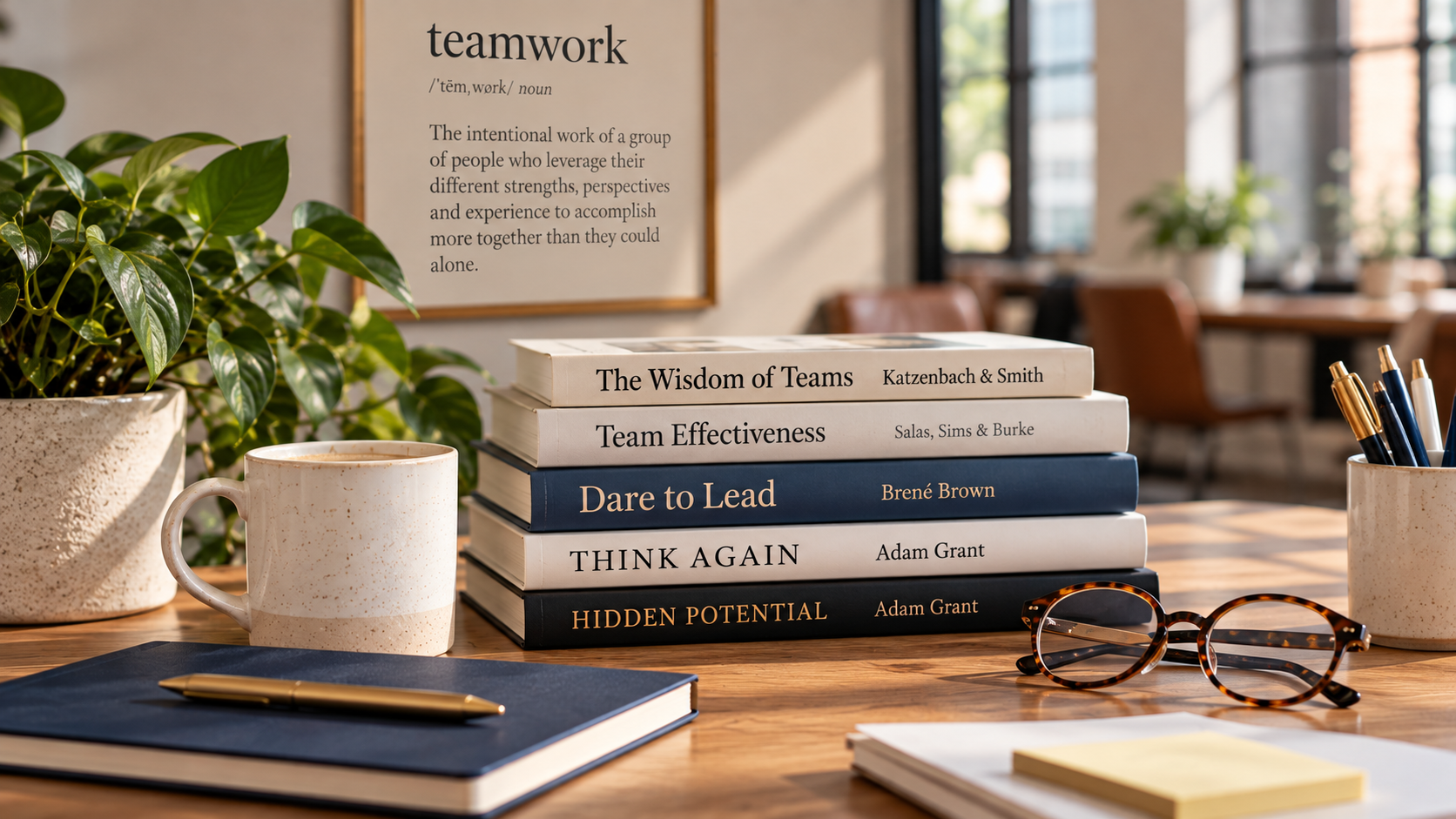
In their foundational work on team performance, Jon Katzenbach and Douglas Smith argued that what distinguishes a real team from a working group isn't simply collaboration. It is shared commitment to a purpose, performance goals, and mutual accountability. Later research has examined everything from team cognition and psychological safety to backup behavior, reflection, and adaptability.
Even Google's well-known Project Aristotle reached a similar conclusion after studying its own teams: who was on a team mattered less than how team members worked together. Google identified five important dynamics—psychological safety, dependability, structure and clarity, meaning, and impact.
Taken together, the research suggests a useful shift in how we think about high-performing teams:
High-performing teams aren't simply collections of high-performing people. They develop ways of working together that allow them to coordinate, challenge, learn, and adapt together.
So what does that actually look like?
1. They create psychological safety—without lowering the bar.
Psychological safety has become one of the most frequently discussed concepts in team development—and perhaps one of the most misunderstood.
It doesn't mean everyone is comfortable all the time. It doesn't mean avoiding difficult feedback, lowering expectations, or making sure nobody's feelings are ever hurt.
Psychological safety is about whether people believe they can take interpersonal risks within the team.
Can I admit that I don't know?
Ask for help?
Raise a concern?
Disagree with the leader?
Point out a mistake—including my own?
That distinction matters because high performance requires both candor and standards.
Google's research found psychological safety to be the most important of the five dynamics associated with its effective teams. But look closely at how Google describes it: people can admit mistakes, ask questions, or offer new ideas without fearing embarrassment or punishment.
A psychologically safe team isn't necessarily a comfortable team.
Sometimes safety is precisely what allows a team to have the uncomfortable conversation it needs to have.
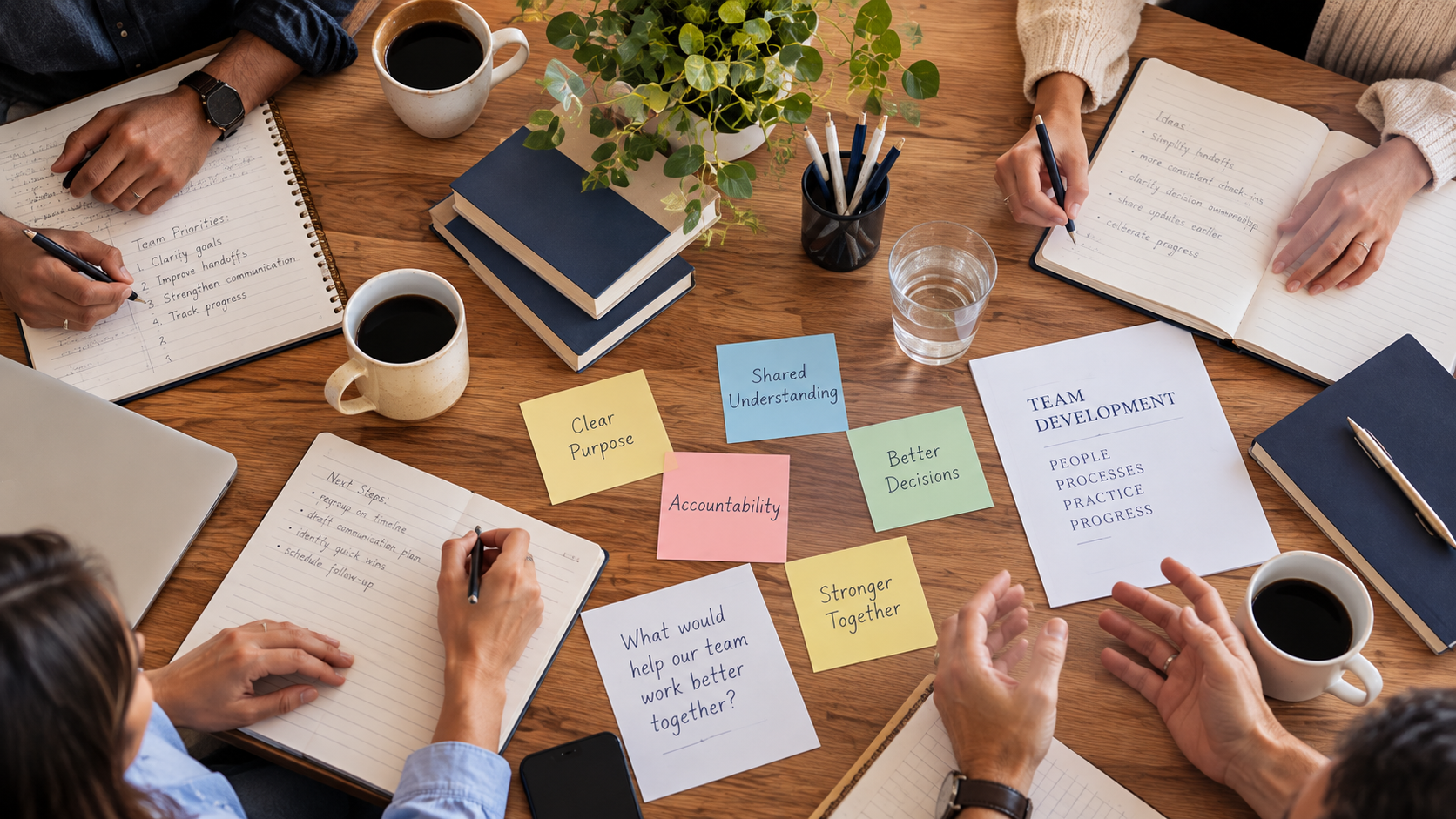
2. They build a shared picture of where they're going.
Ask five people on a team to name the team's three most important priorities. Would you get the same answer?
What about what success looks like?
Who owns which decisions?
What matters most when priorities compete?
Researchers sometimes describe part of this phenomenon as shared mental models—overlapping understandings among team members about the work, the team, and how they operate together.
A recent research study found a meaningful foundation to effective teamwork: a shared understanding was positively related to team processes, motivational states, and performance.
This doesn't mean everyone needs to think alike. It means people need enough of a common map to coordinate.
A team can spend enormous amounts of energy working hard in slightly different directions. High-performing teams keep returning to questions like:
What are we trying to accomplish?
What matters most right now?
What does success look like?
3. They understand how their work fits together.
Knowing your own role is important. Understanding how your role connects to everyone else's is something different.
Teams exist because the work requires people to depend on one another. One person's decision becomes someone else's input. A delayed handoff creates a bottleneck somewhere else. Information held by one person changes what another person should do.
Research on team interdependence distinguishes between simply dividing work among people and designing work in which team members' tasks and outcomes genuinely connect. A meta-analysis found that task interdependence relates to performance through task-focused team processes, while shared outcomes influence more relational aspects of team functioning.
In practice, high-performing teams get curious about the spaces between the boxes on the org chart.
Where are our critical handoffs?
Who needs information from whom?
Where do decisions get stuck?
When my priorities change, who else is affected?
Sometimes what looks like a communication problem is really a coordination problem.
4. They practice mutual accountability.
Accountability is easy to talk about when it travels down the org chart.
A manager holds an employee accountable. A leader checks whether someone met a deadline.
Mutual accountability asks something harder of a team:
Can members hold one another accountable for the work they've committed to doing together?
That idea has deep roots in high-performance-team research. Researchers Katzenbach and Smith identified mutual accountability as part of the discipline that transforms individual contributions into collective performance. Subsequent research has examined what happens when teammates essentially give one another permission to address progress and performance; one study found this kind of informal peer accountability was positively associated with team performance.
And here's where psychological safety and accountability become interesting partners.
If people feel safe but nobody is willing to address missed commitments, performance suffers. If standards are high but questioning, feedback, and mistakes carry interpersonal penalties, people learn to stay quiet.
High-performing teams make room for both.
5. They know when—and how—to back one another up.
One of my favorite concepts from the team research is something called backup behavior.
In their influential review of teamwork research, Eduardo Salas and colleagues identified five core components of teamwork: team leadership, mutual performance monitoring, backup behavior, adaptability, and team orientation. They also identified shared mental models, mutual trust, and closed-loop communication as coordinating mechanisms that support them.
Backup behavior is essentially the team's ability to recognize that another member needs assistance and appropriately shift effort or resources to help.
Strong teams don't operate from That's not my job.
To back someone up well, I need some understanding of what you're responsible for.
I need enough awareness to notice when workload or circumstances have changed.
And I need to know how to step in without creating confusion about who owns what.
They develop enough awareness of the whole to recognize when helping someone else do their job is part of doing theirs.
6. They make room for different perspectives—and actually use them.
Most organizations readily say they value different perspectives.
The more important question is: Do those perspectives actually change the conversation?
Teams can contain different functions, backgrounds, strengths, personalities, experiences, and areas of expertise and still default to the loudest voice, the most senior person, or the way things have always been done.
Having differences on a team doesn't automatically mean the team benefits from them.
The research on team diversity is more nuanced than “diverse teams perform better.” A 2024 study describes two competing possibilities: differences can create synergy when teams exchange and integrate different perspectives, but they can also activate biases and disrupt collaboration.
The potential advantage is that people notice different things, ask different questions, bring different knowledge, and anticipate different risks. High-performing teams create conditions where those differences actually influence how the team thinks and makes decisions.
That's one reason I use tools such as Working Genius®, CliftonStrengths®, and MBTI® in team development. Used well, assessments can make otherwise invisible differences easier to see and discuss. But the assessment itself isn't the outcome. The real value comes when a team learns when those differences matter and how to draw on them more intentionally.
The goal isn't for everyone to contribute in the same way. It's to build a team capable of asking:
Whose perspective haven't we heard yet?
What might someone else be seeing that I am not?
And how might our differences help us arrive at a better answer than any one of us would have reached alone?

7. They examine how they're working—not just what they're producing.
Most teams spend plenty of time reviewing the work.
Far fewer regularly review how they're working together.
Researchers call this team reflexivity: teams reflecting on their goals, strategies, processes, and functioning and making adjustments based on what they notice.
A 2024 research study found evidence that team reflexivity supports performance, while also showing that its benefits depend on factors such as team size and tenure. Interestingly, the analysis also connected leaders who encourage participation with greater psychological safety, which in turn supports greater team reflexivity.
This is one reason I'm skeptical of team development that ends with just the insights - the assessment reports and the initial team debrief are great, but they are most often just the beginning.
It's useful to discover that your team has a pattern. It's more useful to ask:
Where is that pattern showing up in our work?
What is it costing us?
What might we try differently?
How will we know whether it helped?
This is also why thoughtful team building workshops and facilitation can create value beyond a fun afternoon. A facilitated experience gives a team something the normal pace of work rarely provides: structured space to step outside the work long enough to examine how the work is happening.
8. They adapt together.
High performance isn't a state a team reaches and then keeps.
People leave. New people arrive. Strategies change. Workloads spike. A customer’s needs shifts. Technology changes the work. A process that worked beautifully six months ago suddenly doesn't.
Research on team adaptation reinforces this point. A meta-analytic review found that team processes and cognition were positively related to adaptive performance and that context matters: teams may need to respond differently depending on the kind of disruption they're facing.
Adaptation, then, isn't just an individual competency.
It's something teams do together.
They notice that conditions have changed, make sense of what the change means, adjust how they coordinate, and learn from what happens next.
In that sense, this final practice depends on nearly everything before it: safety to name what isn't working, shared understanding to interpret what's changed, accountability and backup behavior to respond, and reflection to learn from the result.
A quick high-performing team check-in:
Think about your team over the last 30 days—not the team you hope you are, but the team you've actually been.
Consider these questions:
Can people disagree, ask for help, or admit a mistake without paying an interpersonal price?
Could everyone name the team's most important priorities right now?
Do people understand not only their responsibilities, but where their work connects with others'?
Can teammates address missed commitments with one another, or does accountability always have to come from the leader?
Do people notice when someone needs backup and know how to provide it?
Do different perspectives genuinely influence the team's thinking and decisions?
Does the team ever stop to examine how it's working?
When circumstances change, can the team adjust together?
Frequently Asked Questions
-
A high-performing team is more than a group of talented individuals. It is a team that consistently produces strong results while developing effective ways to coordinate, communicate, learn, and adapt together. Research on team effectiveness points to factors such as shared purpose, psychological safety, clarity, accountability, coordination, and adaptability.
-
High-performing teams tend to have clear shared goals, psychological safety, mutual accountability, effective coordination, and the ability to learn and adapt. They also understand how members' work connects and can use different perspectives and expertise productively.
-
Psychological safety makes it easier for team members to take interpersonal risks such as asking questions, admitting mistakes, requesting help, challenging assumptions, and offering new ideas. It does not mean lowering performance expectations or avoiding difficult conversations.
-
Mutual accountability means team members share responsibility for the team's collective performance and can hold one another accountable for progress and commitments. It moves accountability beyond something only a manager provides. Research has linked informal peer accountability with stronger team performance.
-
Team building can contribute to performance when it addresses the team's real work and dynamics rather than functioning only as a social activity. Effective team development creates opportunities to examine patterns, strengthen coordination, practice new behaviors, and translate insight into changes in everyday work.
-
An outside facilitator can be particularly useful when a team needs structured space to examine its dynamics, improve alignment or communication, work through persistent patterns, integrate assessment results, or navigate change. Facilitation also allows the team leader to participate in the conversation rather than being responsible for managing it.
High performance takes intentional practice
The research on high-performing teams spans decades, industries, and different theoretical traditions. There isn't one universal checklist. But there is a remarkably consistent idea underneath much of it.
Strong teams aren't simply filled with strong individuals.
They develop ways of thinking, coordinating, challenging, supporting, reflecting, and adapting together.
And those are capabilities teams can develop.
If your team has talented people but isn't getting the traction you'd expect—or if you want to intentionally strengthen these capabilities before problems become entrenched—my team building workshops and facilitated team development experiences are designed around the actual dynamics your team needs to work on.
Or schedule a free consultation and tell me a little about your leadership development needs. We can talk through what's happening, what you'd like to accomplish, and which approach might be the best fit.

Dr. Bethany Peters is a Professional Certified Coach (PCC) and leadership expert who helps individuals, teams, and organizations grow through leadership coaching, executive development, team facilitation, and evidence-based assessments. Whether she's coaching one-on-one or leading a workshop, Bethany creates practical, engaging experiences that help people communicate better, lead with confidence, and create lasting change.