
“If we aren’t going to be afraid of conflict, we have to see it as thinking.”
Have you ever been in a team meeting where you could almost predict what everyone was going to say?
Someone raises a concern about a decision.
Another person immediately pushes back.
The conversation gets a little tense, so someone else tries to smooth things over.
A fourth person goes quiet.
Eventually, the group reaches a compromise, moves on to the next agenda item, and leaves the meeting feeling reasonably productive.
Three weeks later, you're having almost the same conversation.
The issue may be different, but the responses are remarkably familiar.
It's tempting to explain these situations in terms of personality or conflict style…
One person is too confrontational.
Another avoids difficult conversations.
Someone else is always trying to keep the peace.
Those observations may contain some truth, and I’m definitely an advocate for using assessment tools to better understand one another.
At the same time, I’ve observed that a team can be full of capable, well-intentioned people who understand their own conflict styles and still find themselves repeating the same frustrating conversations.
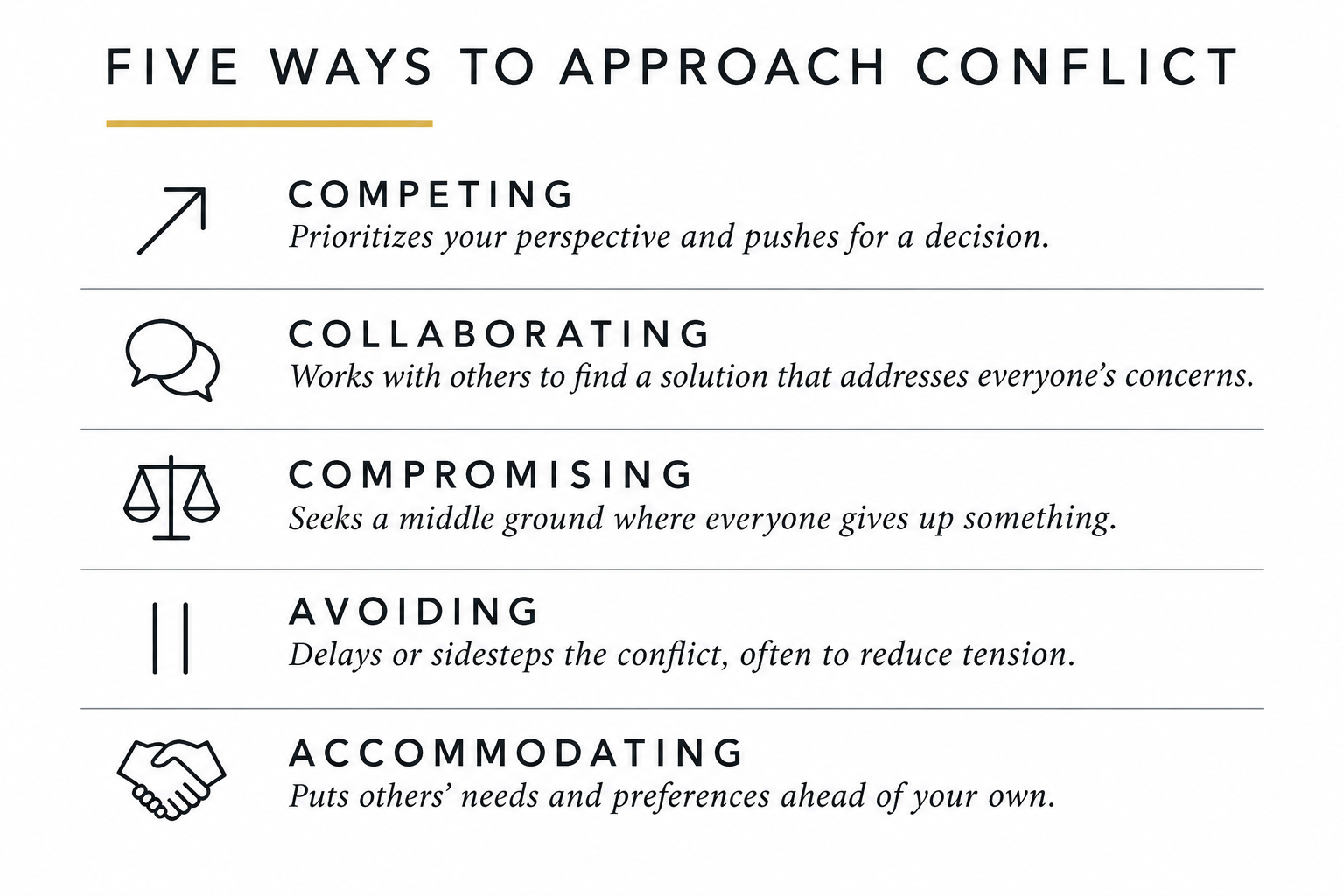
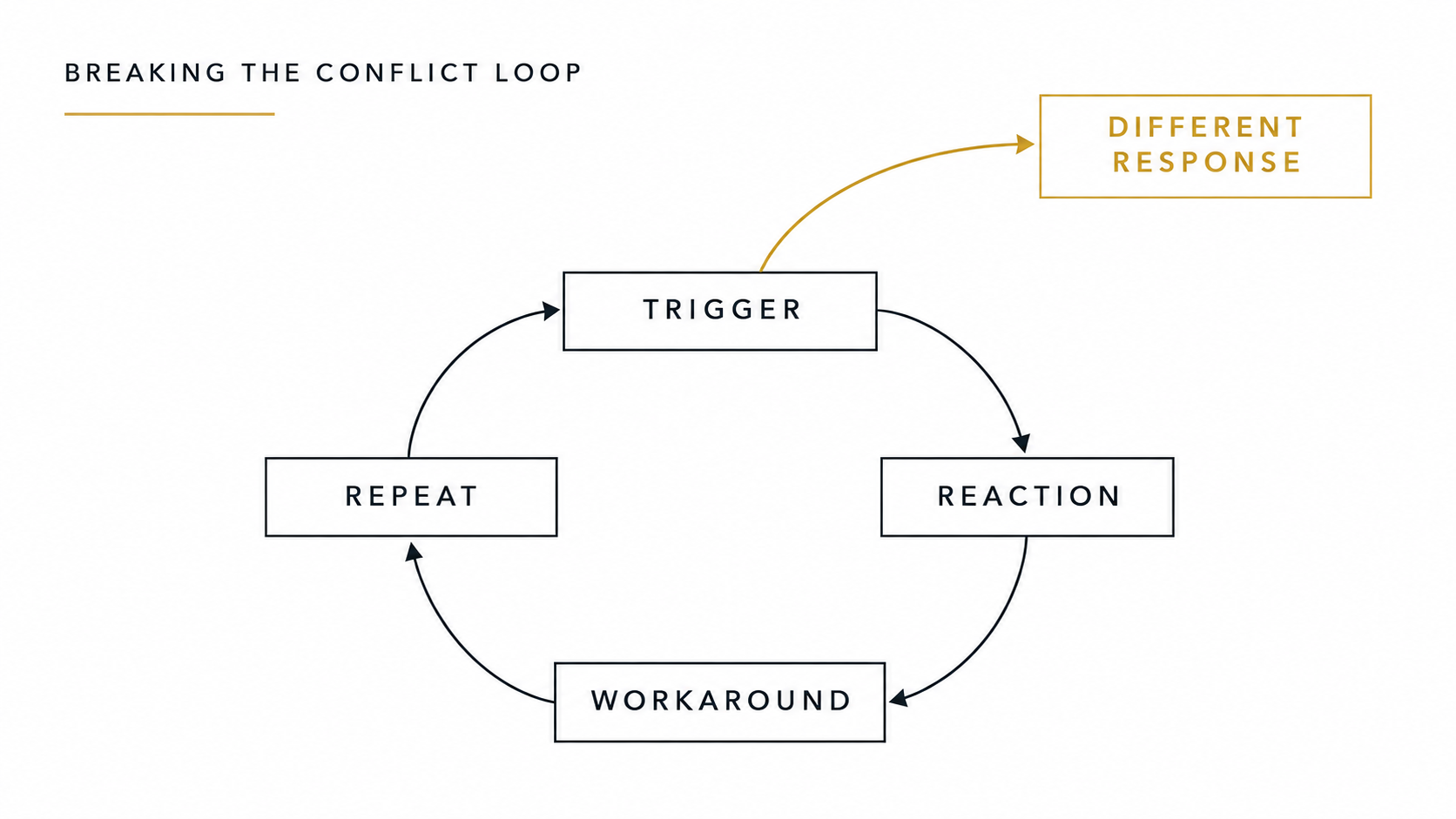
Over time, these repeated interactions can create what researchers call a conflict loop: a familiar pattern of responses that keeps bringing the team back to the same unresolved issues.
Conflict researcher Jennifer Goldman-Wetzler explores this dynamic in her book Optimal Outcomes, describing how our habitual responses to disagreement interact with other people's responses to create a conflict loop. Her work emphasizes that getting unstuck requires looking beyond our individual conflict habits to recognize the patterns we're creating together.
To break the loop, we need to understand how team members' responses influence one another.
The Five Conflict Styles
One of the most widely used frameworks for understanding conflict is the Thomas-Kilmann Conflict Mode Instrument (TKI), developed by Kenneth Thomas and Ralph Kilmann.
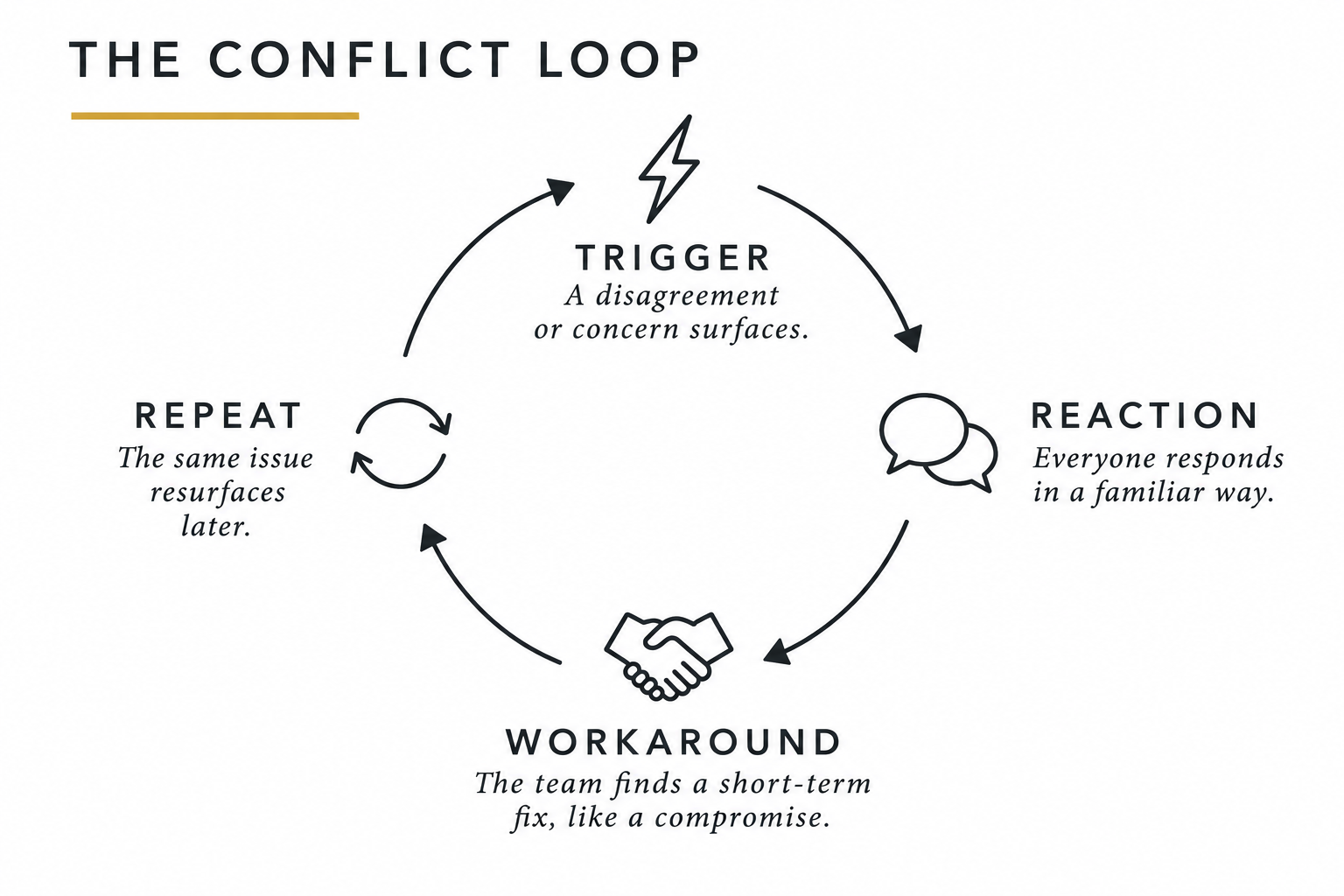
The model identifies five ways people respond to conflict, based on how much they pursue their own concerns and how much they seek to address the concerns of others.
The five conflict styles are:
Competing: Pursuing your own concerns, potentially at the expense of someone else's.
Collaborating: Working together to find a solution that addresses both people's concerns.
Compromising: Finding an acceptable middle ground where each person gives something up.
Avoiding: Choosing not to address the conflict, at least for now.
Accommodating: Setting aside your own concerns to satisfy someone else's.
I appreciate this framework because it helps people recognize that there are several ways to approach disagreement, and each has its advantages and disadvantages:
Competing can be effective when a quick decision is needed or an important principle is at stake. However, relying too heavily on this style can damage relationships or discourage others from sharing their perspectives.
Collaborating allows people to explore different perspectives and develop solutions that address everyone's concerns. The downside is that it takes time and energy, and not every disagreement warrants that level of investment.
Compromising can help people find a practical middle ground and move forward when time or resources are limited. But it may also leave important concerns unresolved if everyone gives something up without addressing the underlying issue.
Avoiding can be appropriate when an issue is relatively unimportant or people need time to gather information or manage their emotions. When used too often, though, it allows important problems to linger or grow.
Accommodating can demonstrate flexibility and strengthen relationships, particularly when an issue matters more to someone else. However, repeatedly setting aside your own concerns can lead to frustration, resentment, or an imbalance in whose needs are considered.
The goal isn't to find the best conflict style. It's to recognize our tendencies and become more intentional about choosing an approach that fits the circumstances.
You can explore the framework further through Kilmann Diagnostics.
But there's another layer to consider, especially when we're working with teams.
Understanding your conflict style can help explain why you tend to respond a certain way. Yet it doesn't quite explain how your response influences the people around you, or how their responses influence what you do next.
And that's where some of the most persistent team conflicts begin.
How Your Team's Conflict Loop Develops
Think about two colleagues who frequently disagree.
One believes that important concerns should be discussed immediately. When something isn't working, she raises it directly and wants to keep talking until there's a resolution.
Her colleague prefers time to process difficult issues. When a conversation gets tense, he becomes quieter, offers shorter responses, or suggests revisiting the topic later.
Neither response is necessarily unreasonable.
But consider what happens when they interact.
The first person interprets the silence as reluctance to engage. She asks more questions and pushes for an answer.
The second person experiences the additional questions as pressure. He withdraws further.
Now the first person is increasingly convinced that the issue is being avoided, and the second person is increasingly convinced that difficult conversations aren't productive.
They leave the interaction frustrated, each believing the other person made it more difficult.
The next time a disagreement arises, they may enter the conversation already expecting the same response.
Over time, this becomes a predictable cycle. One person presses harder because the other withdraws. The other withdraws because the first presses harder.
This is how a conflict loop develops. One person's response influences another person's behavior, which in turn reinforces the first person's reaction. Over time, the sequence becomes familiar, almost like choreography the team has practiced without realizing it.
Organizational learning researcher Chris Argyris described a related phenomenon as defensive routines—the habits people develop to protect themselves or others from embarrassment, discomfort, or perceived threats.
These responses can make sense in the moment. Someone avoids raising a concern to preserve a relationship. Another person softens difficult feedback to keep the conversation comfortable. But when these behaviors become routine, they can make it harder for the team to address the very issues that need attention.
Why the Way Teams Handle Conflict Matters
There's an interesting finding from research on team conflict that helps explain this.
In a 2013 research review, Leslie DeChurch and her colleagues examined 45 studies involving more than 3,200 teams.
They wanted to understand how much a team's outcomes were related to the disagreements themselves and how much was related to the way team members handled those disagreements.
The researchers found that both mattered. But even after accounting for the type and intensity of conflict, how team members interacted during disagreements helped explain differences in team performance and team members' experiences.
I think this is an important finding for leaders.
Two teams can disagree about the same issue and have very different experiences. One may use the disagreement to clarify assumptions, consider new information, and reach a stronger decision. Another may become defensive, withdraw from the conversation, or reach a superficial agreement that leaves the problem unresolved.
The disagreement itself is only part of the story.
The way people respond to one another helps shape what happens next.
This doesn't mean every recurring conflict follows a predictable sequence. Team relationships are influenced by past experiences, organizational expectations, hierarchy, workload, and the decisions people are trying to make.
But when the same frustrations keep resurfacing, looking at the team's interactions may reveal something that individual conflict styles alone cannot explain.
Pay Attention to the Team's Unwritten Rules
Teams develop expectations about how disagreement should happen.
Some are explicit. Others are learned through experience.
Perhaps people have discovered that challenging the leader rarely changes the decision. Maybe the team values harmony so highly that expressing disagreement feels like disloyalty. Or perhaps earlier conversations became personal, and team members have learned to protect themselves by saying less.
Power and authority matter, too. A senior leader's directness carries a different weight than the same behavior coming from a peer. A newer employee's silence may reflect uncertainty about whether it's appropriate to disagree rather than a preference for avoiding conflict.
Over time, these unwritten rules can become so familiar that team members stop questioning them. People learn when to speak up, when to hold back, and which disagreements are worth pursuing. Even when those habits aren't particularly helpful, they can be difficult to change because everyone has adjusted their behavior around them.
Recognizing these patterns is an important first step. It gives the team an opportunity to question the assumptions they've been operating under and consider whether those expectations are still serving them.
When the Pattern Looks Like Harmony
Not every recurring conflict pattern involves an obvious disagreement. Sometimes the pattern is that disagreement rarely happens at all.
Consider a team where meetings are consistently pleasant and decisions appear to come easily. People nod along, offer few objections, and leave with an apparent sense of agreement.
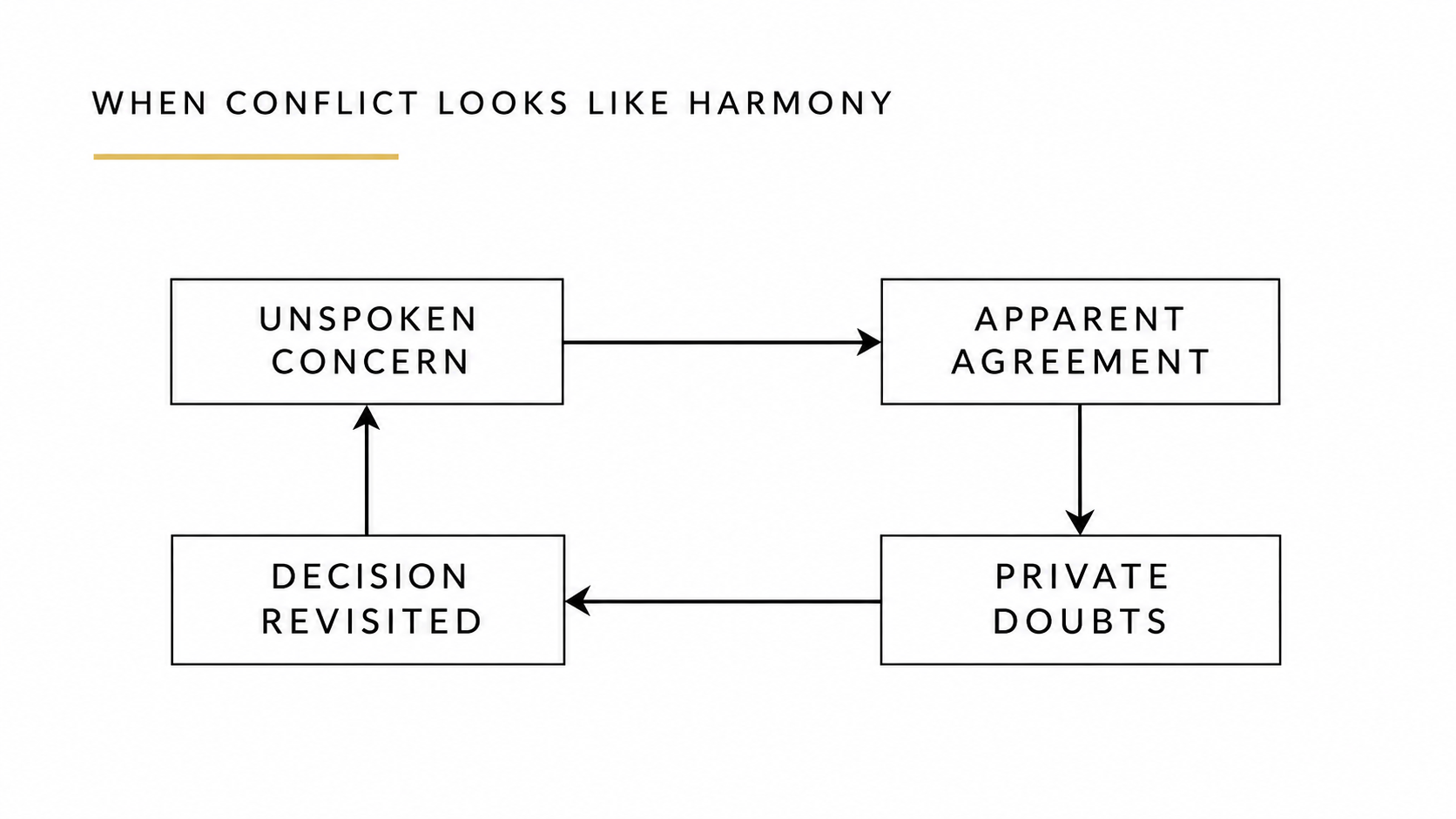
But afterward, concerns surface in one-on-one conversations, commitments are quietly questioned, or decisions are revisited because important perspectives were never shared.
This is another kind of conflict loop. Instead of repeatedly arguing about an issue, the team repeatedly avoids discussing it. The disagreement never fully surfaces, so the decision keeps coming back.
Patrick Lencioni describes this as artificial harmony in The Five Dysfunctions of a Team.
The team may look cooperative, but members have learned that keeping the peace is easier than raising a difficult issue. Over time, silence gets interpreted as agreement, and the lack of disagreement reinforces the belief that everyone is on the same page.
The goal isn't to eliminate conflict, but to help teams engage in the kind of disagreement that leads to better understanding and decisions. Amy Gallo explores this distinction in her Harvard Business Review article, How to Encourage the Right Kind of Conflict on Your Team.
For leaders, this pattern can be particularly difficult to recognize because there may be no visible conflict to address.
One question I like here is:
“What are we not discussing as a team that we're discussing elsewhere?”
It's a question that can help surface the difference between genuine agreement and a team that has simply become very good at avoiding disagreement.
Of course, not every quiet team is avoiding conflict. Some teams genuinely agree, and others prefer to think through concerns before speaking. The more revealing question is whether meaningful differences have a place to surface before decisions are made.
How to Break Your Team's Conflict Loop: Five Practical Steps
When conflict keeps repeating, it's tempting to focus on who needs to communicate differently. But before deciding who needs to change, try examining how the pattern develops and where your team might interrupt it.
1. Identify a Recurring Situation
Choose a disagreement your team has experienced more than once. It might involve project deadlines, competing priorities, or decision-making.
Be specific. Instead of “We struggle with communication,” consider, “Whenever someone questions a deadline, the conversation becomes tense and we move on without resolving the concern.”
For teams that avoid disagreement, look for decisions that seemed settled in a meeting but were questioned afterward.
Ask this: What conversation do we keep having, or avoiding, without making progress?
2. Map the Sequence
Walk through what typically happens. Who raises the concern? How do others respond? Who steps in, and how does the conversation end?
Try to describe observable behaviors rather than assume intentions.
For example:
Concern raised → Pushback → Withdrawal → Quick compromise → Issue resurfaces
Or, with artificial harmony:
Concern goes unspoken → Group agrees → Private doubts emerge → Decision gets revisited
Seeing the sequence helps the team recognize how individual responses contribute to the larger pattern.
3. Understand What's Driving Each Response
People often have reasonable intentions, even when their behavior creates unintended consequences.
Someone pushing for an answer may want to prevent an issue from being ignored. Someone withdrawing may need time to think or want to avoid escalating the disagreement.
Rather than assuming motives, ask:
What were you hoping to accomplish?
How did the other person's response influence yours?
What might others have misunderstood about your intentions?
Understanding these perspectives can help the team see opportunities to respond differently.
4. Interrupt the Pattern
Identify one moment when a different response might change the conversation.
For a team that rushes toward compromise, try asking, “Have we understood everyone's concerns before deciding?”
If silence is mistaken for agreement, ask, “What reservations haven't we discussed yet?”
And if the leader routinely settles disagreements, consider inviting team members to work toward a resolution themselves.
The goal is to experiment with one different response, not change everyone's conflict style at once.
5. Reflect and Adjust
Return to the conversation after the team has had an opportunity to try something different.
Did anyone recognize the familiar pattern? What changed? What still needs attention?
For a team experiencing artificial harmony, progress might mean someone raises a concern during the meeting instead of afterward. For another team, it might mean addressing an underlying issue rather than settling for a quick compromise.
Changing a conflict loop takes practice. Each conversation offers another opportunity to recognize the pattern and make a more intentional choice.
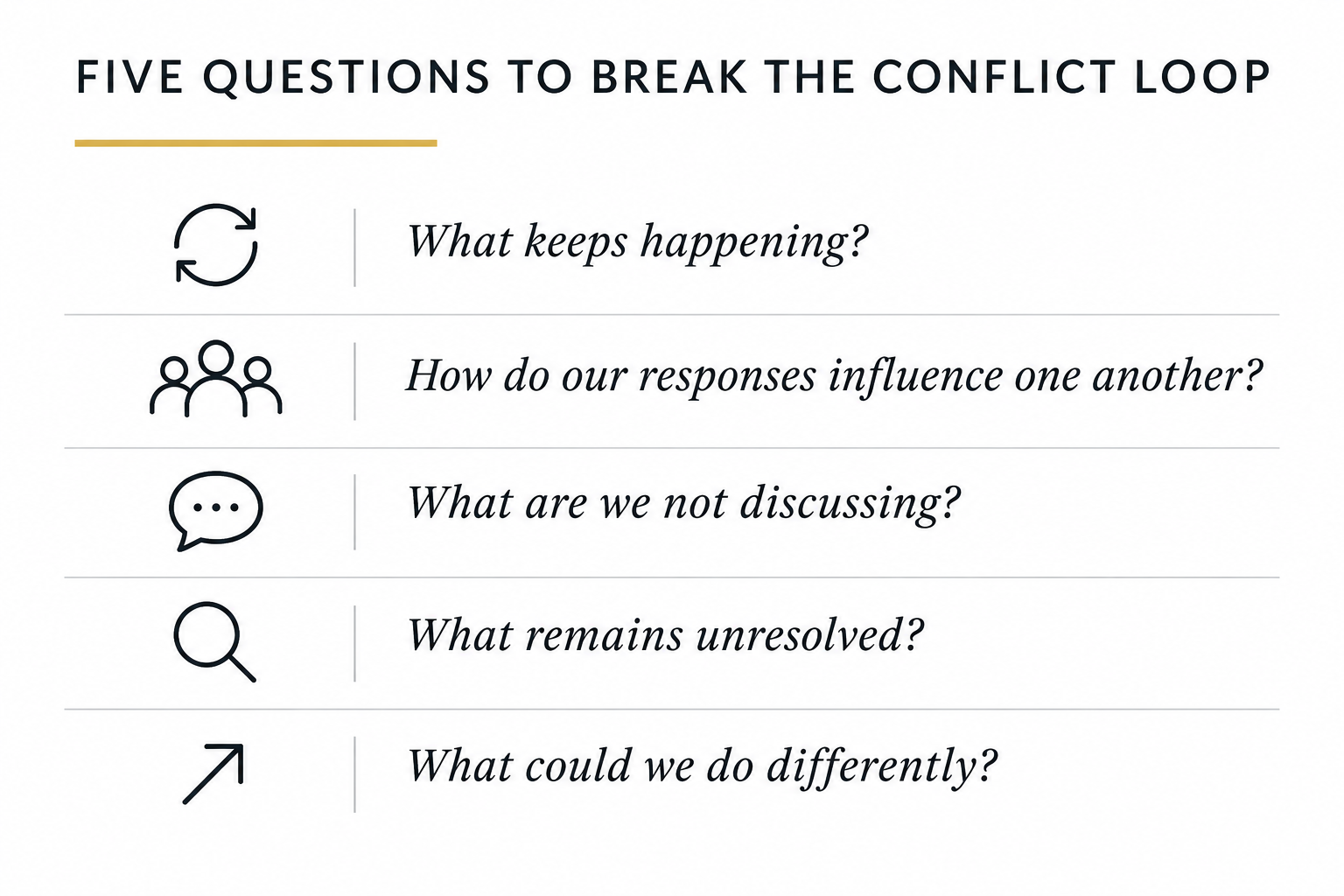
Try This With Your Team: Five Questions to Examine a Recurring Conflict
Think about a disagreement your team has experienced more than once, or an important issue that your team seems reluctant to discuss.
Rather than beginning with who was right or wrong, consider these five questions together:
What starts the pattern? What kind of situation or comment tends to trigger the familiar interaction? Does the pattern begin with an obvious disagreement or with a concern nobody raises?
What happens next? How do people's responses influence what others say or do? Who tends to speak up, become quiet, or redirect the conversation?
How does the conflict usually end? Does the team reach a meaningful resolution, postpone the issue, or simply move on? Is agreement genuine or assumed?
What remains unresolved? Which concerns, assumptions, or decisions tend to resurface? Are there conversations taking place outside the team that need to happen within it?
Where could we make one different move? What might we try the next time the pattern begins?
You don't need to label everyone's conflict style to have this conversation.
You need enough curiosity and candor to examine what's happening without immediately turning the discussion into a search for someone to blame.
When the Team Has Trouble Seeing Its Patterns
Some teams can recognize these dynamics and begin making adjustments on their own.
Others find it much harder, particularly when disagreements involve senior leaders, long-standing relationships, unequal authority, or concerns that have become personally sensitive.
One challenge is that the people trying to understand the pattern are also participating in it. A leader may genuinely want a more open conversation while unintentionally influencing which concerns people feel comfortable raising.
And on teams where artificial harmony has become the norm, members may not initially recognize that anything is missing. Meetings are cordial, decisions appear collaborative, and people rarely challenge one another. The costs may show up later in inconsistent follow-through, quiet frustration, or decisions that keep coming back for discussion.
This is one reason I value team coaching. When we work with a team as a whole, we can observe what happens in real interactions, explore the assumptions shaping those responses, and help team members practice different ways of working together.
Frequently Asked Questions
-
The Thomas-Kilmann model identifies five approaches to conflict: competing, collaborating, compromising, avoiding, and accommodating. Each reflects a different combination of assertiveness and cooperativeness. People can use all five approaches, and the most appropriate response depends on the situation.
-
Recurring conflict may be sustained by patterns in how team members respond to one another. For example, one person's insistence on immediate resolution may lead someone else to withdraw, which prompts the first person to press harder. Unclear roles, decision authority, past experiences, and organizational norms can also contribute to repeated disagreements.
-
Begin by identifying the specific disagreement and listening to the concerns involved. If the conflict keeps recurring, examine the sequence of behaviors that tends to develop, what remains unresolved, and where the team could respond differently. Some situations also require clearer accountability, role definitions, or formal intervention.
-
Artificial harmony occurs when team members avoid productive disagreement to maintain a sense of peace or agreement. Meetings may appear positive, but concerns remain unspoken, decisions are revisited, or frustrations emerge in private conversations. Leaders can address this by creating opportunities for respectful disagreement before decisions are finalized.
-
No. Collaboration can be valuable when both parties' concerns matter and there is time to explore a more complete solution. But other approaches may be more appropriate depending on urgency, the importance of the issue, the relationship, and available resources. Effective conflict management involves choosing an approach intentionally rather than relying on one preferred style.
-
Yes. Teams can begin by identifying recurring situations, describing their interactions without blame, and experimenting with different responses. Team coaching may be useful when patterns are entrenched, difficult to discuss, or hard for team members to recognize while they are participating in them.
Ready to Change How Your Team Handles Conflict?
If your team keeps returning to the same disagreements, or avoiding the conversations that need to happen, another discussion about communication styles may not be enough.
You may need an opportunity to examine how your team actually works together, understand the patterns keeping it stuck, and practice different ways of responding.
At The Leadership Coaching Lab, I partner with leadership teams to strengthen the trust, communication, and clarity they need to work effectively together.
Through team coaching, we look at your team's real interactions and challenges. I combine observation, assessment, coaching conversations, and practical development tools to help team members recognize patterns, work through difficult decisions, and build habits that support lasting progress.
Schedule a free consultation to tell me about your team and explore whether team coaching might be a helpful next step.

Dr. Bethany Peters is a Professional Certified Coach (PCC) and leadership expert who helps individuals, teams, and organizations grow through leadership coaching, executive development, team facilitation, and evidence-based assessments. Whether she's coaching one-on-one or leading a workshop, Bethany creates practical, engaging experiences that help people communicate better, lead with confidence, and create lasting change.