
Great works are performed, not by strength, but by perseverance.
-SAMUEL JOHNSON

Carol Dweck, educational psychologist and researcher, explains how we all have a choice between two mindsets. A fixed mindset is the belief that your capabilities are set and unchangeable. With this mindset, failure and criticism are seen as confirmation of one’s flaws and limitations. On the other hand, with a growth mindset, we see our abilities as the starting point for development, in which failures and feedback can be reframed to fuel our future growth. Read more about the essentials of growth mindset in this HBR article authored by Dweck.
Research shows that having a growth mindset can positively influence motivation, performance, and resilience. So how can you encourage a growth mindset in yourself or others?
One approach that I use frequently in my teaching and coaching is to pair the use of self-assessment tools (such as CliftonStrengths, MBTI, etc.) with the principles of growth mindset. Self-assessment can encourage the development of a growth mindset through:
Identifying personal strengths and weaknesses
Increasing awareness of blind spots and barriers to growth
Indicating specific strategies for future development
In a previous blog post, I discussed factors to consider when choosing a self-assessment. In this post, I will recommend how to apply a growth mindset to three specific self-assessments: CliftonStrengths, the Enneagram, and the Myers-Briggs Type Indicator (MBTI).
CliftonStrengths
The CliftonStrengths assessment generates a report that features an individual’s top five talent themes. The key idea behind CliftonStrengths is that individuals will be more fulfilled and engaged if they focus on investing in their natural talents rather than trying to improve weaknesses.
Essential Vocabulary: Learn the language of 34 unique talent themes, representing areas of natural gifts. A strength represents the capacity to contribute nearly flawless performance on a consistent basis. However, talents are not considered strengths until they are refined and effectively managed.
Growth Path: Identify how to apply each talent most effectively (your balcony) and how to adapt when over- or under-using a strength (your basement).
—> Fixed Mindset: I have predetermined strengths and weaknesses that won’t change.
—> Growth Mindset: I can refine my raw talents into strengths with hard work and practice.
Resources:


The Enneagram
The Enneagram typology provides an opportunity to assess how one relates to self and others. Nine types each represent unique fears, motivations, and behavior patterns that emerge in times of stress and security.
Essential Vocabulary: Learn the language of the 9 Enneagram Types, the Enneagram Wings, and Subtypes. The nine Enneagram types are distinguished by internal motivations and desires, so two types could have similar behaviors but very different motivations.
Growth Path: Understand the deep drivers behind your mindsets and behaviors, and apply self-development strategies unique to your type.
—> Fixed Mindset: I see unhealthy mindsets and motivations as unfixable flaws.
—> Growth Mindset: I can transform unhealthy mindsets and motivations through type-specific self-development strategies.
Resources:
Myers Briggs Type Indicator (MBTI)
The Myers Briggs Type Indicator (MBTI) provides a personality assessment based on the theory of Carl Jung, assessing four pairs of preferences: extroversion & introversion, sensing & intuition, thinking & feeling, and judging & perceiving.
Essential Vocabulary: Learn the key differences between the four pairs of preferences and sixteen types.
Growth Path: Recognize and leverage the unique strengths of your type. Effectively manage your approach to communication, decision-making, and leadership.
—> Fixed Mindset: I have no power over my personality preferences.
—> Growth Mindset: I can manage my personality preferences to more closely align with my values and goals.
Resources:

Rate Your Self-Awareness
How well do you really know yourself? And how closely does your understanding of yourself match the way others experience you?
Self-awareness is foundational to effective leadership, meaningful relationships, and personal growth. Yet understanding ourselves involves more than reflecting on our own thoughts, feelings, and behaviors. It also requires understanding how we come across to others.
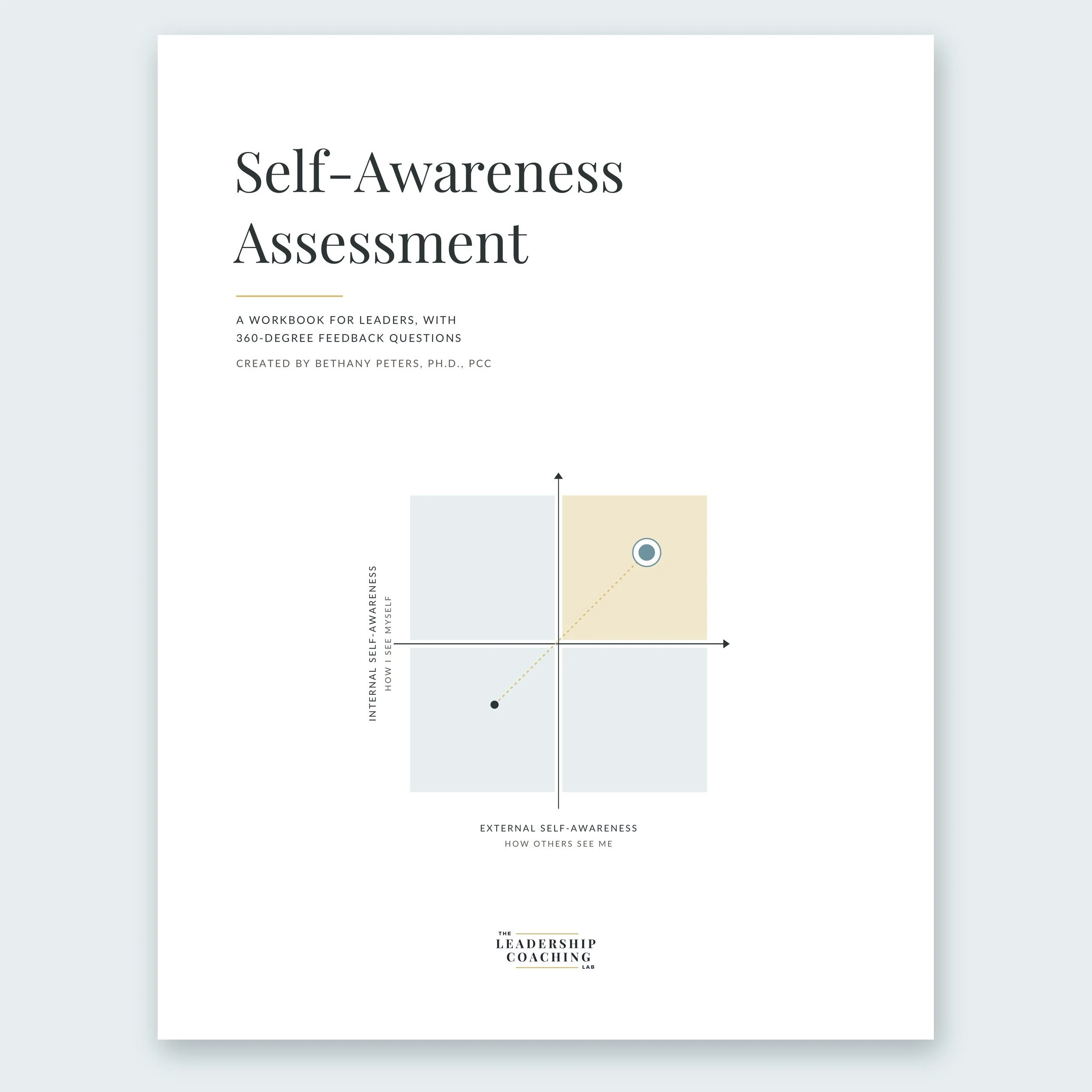
The Self-Awareness Assessment & Workbook is a guided development tool that helps you explore both internal and external self-awareness, recognize your strengths and blind spots, and identify opportunities for growth.
You'll begin with a self-awareness assessment, explore your results through guided reflection, and gather feedback from others. You'll then use those insights to create a personalized action plan for strengthening your self-awareness over time.
What's Inside
Johari Window Exercise: Explore what you know about yourself, what others see in you, and where you may have blind spots.
Self-Awareness Assessment: Rate 16 statements to assess your internal and external self-awareness, with automatic scoring.
Personal Results Profile: Explore your scores and see where you fall within a four-part self-awareness quadrant.
Guided Reflection: Work through seven full-page journaling prompts to deepen your understanding of yourself and your results.
Informal 360-Degree Feedback: Gather perspectives from others using 20 feedback questions and a ready-to-send feedback request letter.
Self vs. Others Comparison: Explore similarities and differences between how you see yourself and how others experience you.
Self-Awareness Snapshot: Bring your key insights together in a one-page summary.
Personal Development Action Plans: Use three action planning tools and a growth tracker to translate your insights into meaningful changes.
Designed for Easy Use
This interactive workbook automatically calculates your internal and external self-awareness scores and carries your results into the relevant sections. You can spend more time reflecting on your insights and less time calculating scores or re-entering information.
Use the workbook independently, as part of a coaching engagement, or alongside a leadership development program.
Product Details
40-page fillable PDF
US Letter size (8.5 × 11 inches)
Instant digital download
Complete digitally or print and write by hand
For automatic scoring and full interactive functionality, use Adobe Acrobat Reader. Mac Preview supports fillable fields but does not support automatic calculations.
About the Creator
Dr. Bethany Peters, Ph.D., PCC, is the founder of The Leadership Coaching Lab and has more than 20 years of experience across higher education, leadership development, coaching, and team development. She is a Professional Certified Coach through the International Coaching Federation and writes regularly about leadership and professional development.
Bethany creates research-informed tools that draw on her experience coaching leaders, developing teams, and teaching leadership. Her resources are designed to help people move beyond reflection to meaningful action in their personal and professional lives.
If you are a coach looking for a baseline tool to use with your clients, or an individual who wants to go deeper in your personal growth process, download our custom-designed self-awareness assessment, which is a comprehensive 20-page digital download designed for both coaches who are looking for client assessments, and for individuals who are committed to personal growth. Includes:
Self-Awareness Rating Scale: Gauge your self-awareness with a carefully crafted rating scale, allowing you to assess various facets of your personality, emotions, and behaviors.
Questions for Reflection: Dive deep into introspection with thought-provoking questions designed to uncover hidden insights and foster a profound understanding of your motivations and aspirations.
Journal Prompts: Encouraging self-expression, the assessment includes journal prompts to guide you through the process of recording your thoughts, emotions, and personal growth journey.
Guidelines for an Informal 360 Review: Capture diverse perspectives with step-by-step guidelines on conducting an informal 360 review.
Questions for Informal 360 Review: Facilitate meaningful conversations with colleagues, friends, or mentors using targeted questions to gather constructive feedback and gain valuable external insights.
Inspiring Quote Pages: Stay motivated and focused on your self-awareness journey with pages featuring inspiring quotes that resonate with the themes of introspection, growth, and authenticity.
Book Recommendations: Strengthen your self-awareness toolkit with carefully curated book recommendations, handpicked to further enrich your understanding of yourself and propel your personal development.
Get the Guide to Inspire Intentional Growth
Get the free guide, Growth by Design: A Leader's Guide to Intentional Growth, featuring an assessment to map your growth zone, a set of growth-mindset coaching questions, and the growth sprint method.
You'll also join 3,000+ leaders and coaches who read The Coaching Mindset.