40 Coaching Questions to Ask About Your CliftonStrengths Results
“There is no more effective way to empower people than to see each person in terms of his or her strengths.”
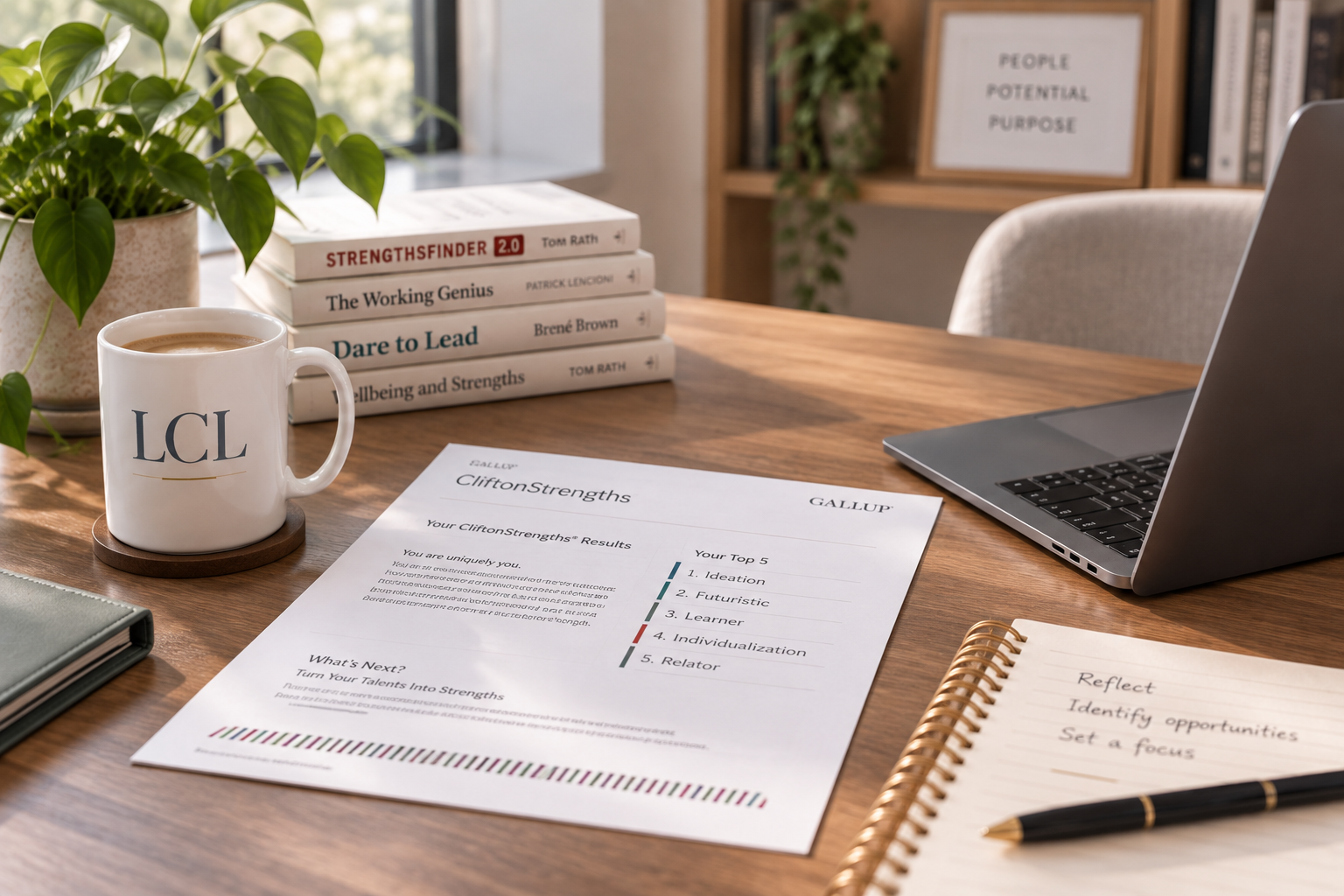
You took the CliftonStrengths assessment. You opened your report, read through your Top 5, and probably had at least one moment of, Yes. That is absolutely me.
Now what?
This is where I see people stop too soon with assessments. Knowing that you're Strategic, Achiever, Relator, Learner—or any of the other 34 CliftonStrengths themes—can give you useful language for understanding yourself. But knowing the names of your strengths doesn't automatically change how you work or lead.
The more interesting questions come next.
Where can you actually see these talents in your life? How do they work together? When are they helping you? When might they be getting in your way? And what could you do differently because you understand yourself a little better?
Gallup describes strengths development as an ongoing process of understanding and intentionally applying our talents. Their familiar “Name it, Claim it, Aim it” framework captures the progression well: learning the language is only the beginning.
The 40 CliftonStrengths coaching questions below are designed to help you go further with your results. You can use them on your own, bring them into a conversation with your manager or team, or use them with a coach.
And you certainly don't need to answer all 40 at once. Start with the questions that draw you in the most

YOUR QUICK STRENGTHS DEBRIEF1. Which strength surprised you the most?
2. Where do you see it in action?
3. Which strengths seem to work together?
4. Which strength do you overuse? 5. Which strength could you use more intentionally? Start With Your Reaction to Your CliftonStrengths Results
Before you analyze your results, pay attention to your reaction to them.
Gallup's reports include personalized descriptions because two people with the same theme don't necessarily experience or express it in exactly the same way. Your combination of talents—and how you've developed and used them—is part of what makes the results useful.
Start here:
Which of your Top 5 CliftonStrengths felt immediately accurate?
Which result surprised you most?
Is there a theme you aren't sure you see in yourself yet?
Which words or phrases in your report sound particularly like you?
Is there a strength you were especially pleased to see in your results?
Is there one you wish weren't there—or another theme you wish had appeared instead?
That last question can be particularly interesting. Sometimes we have ideas about the strengths a good leader should have, and those expectations shape how we react to the talents we actually have.
Rather than asking whether you received the "right" strengths, get curious about what your reaction is telling you.
Look for Evidence in Your Own Experience
An assessment result becomes much more useful when you can connect it to actual experiences.
Choose one of your Top 5 and ask:
Where have you seen this talent show up throughout your life?
When has this strength helped you do something particularly well?
What kinds of problems do people naturally come to you to solve?
What do you do well that you may have assumed everyone else could do?
When does using this strength feel especially satisfying or energizing?
What feedback have you received from other people that might connect to this strength?
This is one reason I like coaching questions alongside assessment results. Instead of asking, Does this description sound like me?, you're beginning to test the result against your own experience.
The report gives you a hypothesis. Your life gives you the evidence.

Pay Attention to How Your Strengths Work Together
Your strengths don't operate in isolation.
Your strengths themes interact dynamically. One may shape how another gets expressed, and the combination can be more revealing than either theme on its own.
Gallup encourages people to consider the unique combination of their dominant themes rather than treating each strength as an isolated label.
Try these questions:
Which two of your strengths seem to reinforce one another?
Which combination feels particularly characteristic of how you work?
Are there two strengths that sometimes pull you in different directions?
Which strength tends to show up first when you're solving a problem?
Which themes do you rely on when you're under pressure?
How might one of your strengths change the way another one shows up?
This is often where CliftonStrengths starts becoming much more individual and customized to you.
Knowing what Learner means is useful. Understanding what your Learner looks like when it's operating alongside your other dominant talents is more useful.
Look at the Other Side of a Strength
Strengths-based development doesn't mean pretending weaknesses don't exist.
In fact, Gallup defines a weakness broadly as anything that gets in the way of your success. A dominant talent can become part of a weakness when it is poorly applied or creates a blind spot.
That's why some of the most useful CliftonStrengths coaching questions aren't about what you're great at. They're about what happens when one of your greatest talents isn't serving you particularly well.
When has one of your strengths become "too much of a good thing"?
How might someone else experience this strength differently than you intend?
What do you tend to overlook because your natural attention goes somewhere else?
Is there a strength you rely on even when the situation might call for a different approach?
What feedback is hardest for you to hear—and could one of your strengths help explain why?
Where might one of your strengths be getting in the way of the outcome you want?
The goal isn't to become less of who you are. It's to become more skillful in how you use what you naturally bring.
Consider What Comes Less Naturally
If you have your full CliftonStrengths 34 report, it can be tempting to scroll straight to the bottom and think, There are my weaknesses.
That's not quite how CliftonStrengths works.
Gallup is clear that your lower themes aren't automatically weaknesses. They simply represent patterns that are less natural or less dominant for you. A lower theme becomes important when its absence is actually interfering with something you need to accomplish.
Instead of asking how to "fix" your bottom strengths, ask:
What important parts of your role don't come naturally to you?
Where do you expend considerably more effort than other people seem to?
Is there a lower theme you genuinely need in your role—or are you assuming you should be good at everything?
Which of your stronger talents could help you accomplish something that doesn't come naturally?
Where could you partner with someone whose natural strengths complement yours?
That's a very different developmental question from How do I get better at my weaknesses?
Sometimes development means building a skill. Sometimes it means using another strength to get there. And sometimes it means recognizing that someone else can do something extraordinarily well that you don't need to do alone.
Connect Your CliftonStrengths to Your Work
This is where the assessment starts becoming really practical.
Your strengths aren't especially useful sitting in a report. The question is what they tell you about the way you do your actual work.
Which parts of your current role give you the greatest opportunity to use your strengths?
Where do you feel like some of your strongest talents are underused?
Which responsibilities allow you to do some of your best work?
Is there a task, project, or responsibility you could approach differently by intentionally using one of your strengths?
What is one small change you could make to create more opportunity to use what you naturally do well?
That doesn't necessarily mean redesigning your entire job around your Top 5. Most of us have responsibilities that aren't perfectly aligned with our natural talents.
But it does mean asking whether you can become more intentional about how you approach the work you already have.
Ask How Other People Experience Your Strengths
Self-awareness is only one side of leadership development.
Your strengths also shape how other people experience working with you.
What do you naturally contribute to a team that others may rely on more than you realize?
What do you expect other people to do because it comes naturally to you?
Which of your strengths is most visible to the people you work with?
Which strength might be easy for other people to misunderstand?
What does your team need from you that your strengths can help you provide?
What is one strength you want to use more intentionally in the way you lead, collaborate, or communicate?
That final question is where I would spend some quality time.
Because the point of CliftonStrengths isn't solely to describe yourself more accurately. It's to do something more impactful with what you've learned.
Come Back to These Questions
Forty questions is a lot—and that's intentional.
This isn't meant to be a worksheet you race through in one sitting.
Your CliftonStrengths results can be something you return to as your role, responsibilities, challenges, and goals change.
You might choose three questions that feel particularly relevant right now. Journal about one. Bring another into your next conversation with your manager. Ask someone who knows you well how they would answer one of the questions about you.
Then come back to the list six months from now and see what you notice differently.
Gallup describes strengths development as something that continues as our self-awareness grows and as we encounter new opportunities to apply our talents.
The assessment gives you language.
The questions help you make meaning from it.
And what you do with those insights is where development begins.
40 Coaching Questions to Ask About Your CliftonStrengths Results
Frequently Asked Questions
-
Start by reading your report closely and identifying the descriptions that resonate most strongly. Then connect your themes to specific experiences: where you see them in your work, when they have contributed to success, how other people experience them, and where they may create blind spots. The goal is to move from knowing the names of your strengths to intentionally applying them.
-
Useful CliftonStrengths questions go beyond "Does this sound like me?" Ask where you've seen each talent in action, how your themes interact, when a strength has helped or hindered you, what comes less naturally, how other people experience your strengths, and how you could use them more intentionally in your current work.
-
Your dominant themes are the natural place to begin because CliftonStrengths is designed around developing your strongest talents. If you have your full CliftonStrengths 34 results, your lower themes can also provide useful information about what may come less naturally. Gallup cautions that lower-ranked themes aren't automatically weaknesses.
-
Yes. Gallup defines a weakness as anything that gets in the way of success, and even a dominant talent can hinder effectiveness when it is poorly applied or overused. Understanding potential blind spots is therefore part of strengths development.
-
Absolutely. Your report and reflective questions like these can help you begin making connections on your own. A coach can add another layer by noticing patterns across your results and experiences, asking questions you may not think to ask yourself, challenging assumptions, and helping you translate insight into action.
-
A Gallup Certified Strengths Coach helps individuals and teams understand and apply their CliftonStrengths results. Rather than simply explaining theme definitions, coaching can help connect the assessment to real goals, leadership challenges, relationships, work patterns, and development.
Ready to Go Deeper With Your CliftonStrengths?
You can learn a lot by sitting down with your report and the right questions.
But there are also limits to what we can see about ourselves by ourselves.
A coaching conversation creates space to examine the patterns underneath your results: how your strengths work together, where they're showing up in your leadership, where they may be creating blind spots, and how you can use them more intentionally in the work you're doing right now.
As a Gallup Certified Strengths Coach, I work with leaders and teams to move beyond simply knowing their CliftonStrengths results and start applying them to the way they actually work and lead.
If you've taken CliftonStrengths and are wondering what to do with your results next, that's exactly where we can start.
Or schedule a free consultation and tell me a little about your leadership development needs. We can talk through what's happening, what you'd like to accomplish, and which approach might be the best fit.

Dr. Bethany Peters is a Professional Certified Coach (PCC) and leadership expert who helps individuals, teams, and organizations grow through leadership coaching, executive development, team facilitation, and evidence-based assessments. Whether she's coaching one-on-one or leading a workshop, Bethany creates practical, engaging experiences that help people communicate better, lead with confidence, and create lasting change.