
6 Tips to Take a Coach Approach
Last updated May 8, 2026

What is your capacity for coaching others to greater growth and discovery?
Build coaching skills into your leadership approach
What is your capacity to take a coach approach with the people you lead? Building coaching skills into your leadership style starts with these essential shifts: from telling to asking, from fixing to facilitating, from directing to drawing out.
I distinctly remember one of my first supervisors in my career … she was a manager who was known for being great to work for. So, how did this greatness play out day to day?
She asked thoughtful, intentional questions that pushed me to think more strategically.
She took time to ask my opinions on important topics.
She empowered me to make choices and take initiative, while letting me know she was always in my corner.
Thoughtful questioning, intentional listening, and a clear commitment to my growth and potential were some of the distinct differentiators of her style.
As a result of her informal coaching, I enjoyed coming to work, grew in confidence, contributed new ideas, took on meaningful projects, gained more responsibility, AND was quickly promoted.
Her investment in me went far beyond my performance in that first job … the generous space she created for me to grow and develop influenced me deeply.
Her impact was transformative.
What is a Coach Approach?
A coach approach is a leadership and communication style centered on asking thoughtful questions, listening deeply, and empowering others to discover their own insights and solutions. Rather than defaulting to telling, fixing, or directing, leaders who take a coach approach create space for the people around them to think more clearly, take ownership, and grow into greater capability. It's a fundamental shift from advice-giving to facilitating—and one that transforms not just individual conversations, but the broader culture of teams, families, and relationships.
What’s the Value in a Coach Approach?

Maybe you are in a leadership role and know your current style isn’t working. Or maybe you want to help your team grow and develop more strategically. Perhaps you feel your team is disengaged and can’t figure out how to provide a different kind of support.
According to recent research conducted by Google, employees desire managers who can skillfully coach them— and this desire ranks as a top rated (no. 1) manager behavior.
Coaching takes time and intentionality, and it isn’t very often modeled, taught, or encouraged in organizations. Coaching isn’t as efficient as advice-giving, and it isn’t always the appropriate leadership style or intervention to apply.
However, research shows us that those who are coached experience many benefits, including greater capability, clarity, confidence, among a range of other benefits (read more on the research-based benefits here). Leadership scholars Milner and McCarthy have even demonstrated how coaching has significant similarities to a transformational leadership style.
What’s Your Current Approach?
So, how exactly do you embrace a coaching mindset as a manager or leader? As a friend or colleague? As a partner or parent?
Deciding whether or not to integrate a coach approach into your role is something that requires wisdom and discernment. The first important step is to consider what your current approach is, and determine how it’s working for you.
Pick a specific context, and decide where you most frequently land on this coaching continuum —>
Are you an expert advice-giver or a committed question-asker?
Do you listen to respond or listen to understand?
Do you default to making immediate suggestions, or have you built a habit of supporting others to solve their own problems?
With your current strategies, what impact are you having? Is it the impact that you want to have?
Take a recent situation in which you took a directive approach, and reframe it to see how your impact might be different by taking a coach approach.

Need a Better Set of Coaching Questions?
Building a coaching question repertoire takes time—but you don't have to start from scratch. 100 Coaching Questions for Leaders: A Complete Guide gives you 100 powerful questions organized across ten leadership categories, plus templates and reflection prompts to help you take a coach approach with confidence.
Six Tips to Apply a Coach Approach
You don’t have to be a professional coach to benefit from developing your coaching skills. In whatever role you serve, you have a unique opportunity to apply coaching strategies to enhance your relationships and transform your conversations.
Tip 1: Clarify Coaching Goals
Before you can take a coach approach, it’s essential to define your purpose and desired outcomes. For what purposes can applying coaching skills be most valuable—professional development, personal growth, or team performance? Consider the relationships in your life that could benefit most from a coaching approach and reflect on the specific skills you need to refine. If you’re mentoring or supervising someone, clarify their growth goals and explore ways you can support them effectively through coaching. Establishing clear objectives ensures that your efforts are intentional and impactful.
For what purposes can applying coaching skills be most valuable?
What relationships in your life would benefit most from a coach approach?
What specific coaching skills do you most need to refine?
If you are mentoring or supervising someone, what are their specific goals for growth and development? How can you support them through coaching?
Tip 2: Identify ‘Coachable’ Moments
Not every interaction requires a coaching approach. Observe situations where stepping back, listening, and facilitating reflection could have the greatest impact. These optimal coaching moments often occur when someone is struggling with a challenge, making a decision, or seeking guidance. Outside the workplace, consider opportunities to practice coaching with family, friends, or children—helping others explore solutions rather than giving direct advice. Recognizing these moments allows you to apply coaching intentionally, rather than reacting automatically.
When is it most valuable to take more of a facilitating, non-directive coach approach? In which situations?
What situations represent optimal coaching moments?
Outside of the workplace, when would it be meaningful to try a coach approach? With family? Friends? Your kids?
Tip 3: Develop Deeper Listening
Effective coaching begins with deep listening. Reflect on your current capacity to hear, understand, and observe without immediately offering solutions. Identify your most frequent barriers—interrupting, assuming, or thinking ahead—and practice pausing to fully absorb what the other person is communicating. Deep listening not only builds trust but also uncovers insights that might otherwise be missed, allowing for more meaningful and impactful coaching interactions.
What is your current capacity to listen deeply, to take the time to hear, understand, reflect, and observe?
What are your most frequent barriers to listening more effectively?
Tip 4: Ask Powerful Questions
“When you build a coaching habit, you can more easily break out of three vicious circles that plague our workplaces: creating overdependence, getting overwhelmed and becoming disconnected.”
The heart of coaching is asking questions that prompt reflection and discovery. Examine the types of questions you typically ask and consider whether they guide others toward new perspectives or creative problem-solving. Powerful questions encourage exploration, self-awareness, and ownership of solutions. By honing your ability to ask thought-provoking questions, you enable others to find clarity and develop actionable strategies for growth.
What types of questions do you typically ask? What do those questions help you accomplish?
How would you rate your ability to ask questions that help others see new perspective or solve problems more creatively?
Tip 5: Encourage Awareness & Action
Coaching is most effective when it leads to both insight and action. Reflect on the strategies you use to help others gain awareness—whether through feedback, prompting reflection, or exploring consequences. Consider how you hold people accountable for translating new understanding into behavior and reaching their goals. Encouraging awareness and supporting action bridges the gap between intention and results, making coaching practical and results-oriented.
What strategies do you use to help others gain new insight?
In what ways do you hold others accountable to developing their potential and reaching their goals?
Tip 6: Leverage Your Strengths
Your unique strengths shape how effectively you coach others. Reflect on the qualities—empathy, curiosity, analytical thinking, patience—that you naturally bring to interactions. How can these strengths enhance your ability to adopt a coaching mindset and support others’ growth? Leveraging your strengths not only increases your confidence as a coach but also ensures your approach is authentic, sustainable, and aligned with your natural style.
What unique strengths do you possess that can help you leverage a coaching mindset more effectively?
100 Essential Questions to Take a Coach Approach
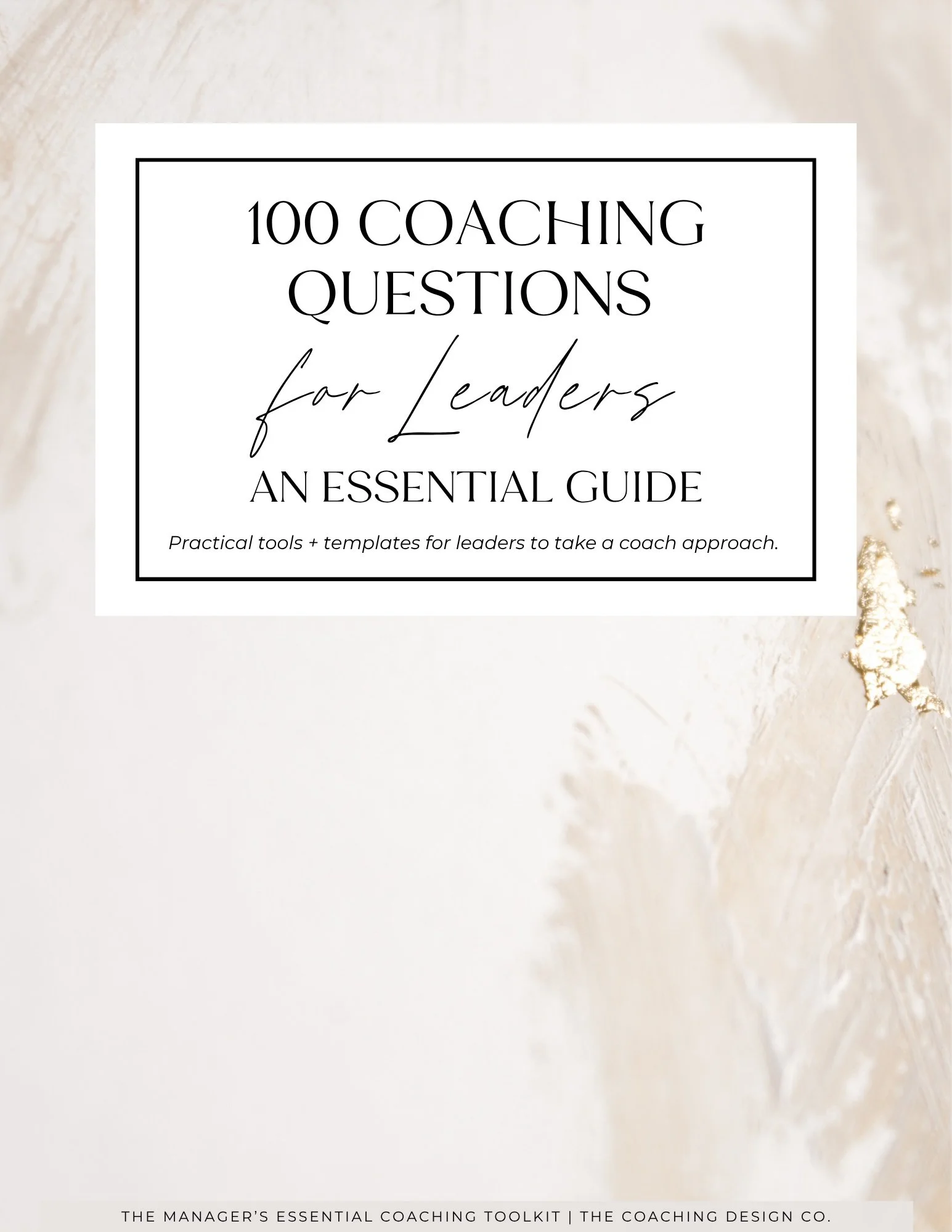
Transform Your Leadership Style with 100 Powerful Coaching Questions for Leaders
100 Powerful Coaching Questions for Leaders: Organized into 10 key leadership categories, these coaching questions will help you facilitate insightful conversations, encourage self-reflection, and drive positive change within your team. The categories include:
Self-Awareness: Foster deeper understanding and personal growth.
Productivity: Enhance efficiency and time management.
Decision-Making: Improve judgment and problem-solving skills.
Vision & Strategy: Align individual and team efforts with organizational goals.
Communication & Influence: Strengthen interpersonal skills and impact.
Mentoring & Development: Guide and support the growth of your team members.
Team Building: Cultivate collaboration and high-performing teams.
Managing Stress: Help individuals navigate challenges and maintain well-being.
Change Management: Support team members through transitions and new initiatives.
Managing Performance: Provide constructive feedback and drive improvement.
Essential Coaching Tips and Templates: Learn fundamental coaching skills and immediately implement ready-to-use templates for various coaching conversations.
Coachability Assessment: Understand your team members' readiness for coaching and tailor your approach. This assessment helps you identify where coaching will be most effective.
Goal-Setting Exercise for Leaders: Develop your own coaching goals and create a roadmap for integrating coaching into your leadership style.
10 Inspirational Quote Posters: Stay motivated with these inspirational quote posters designed to support your growth as a coaching leader.
Who is this toolkit for?
New leaders looking to build a strong foundation in leadership coaching skills.
Experienced leaders wanting to enhance their coaching abilities and adopt a more coach-like leadership style.
Managers transitioning into broader leadership roles who need a complete guide to coaching their teams.
HR professionals and leadership development trainers seeking valuable coaching resources for their programs.
Coaches who specialize in leadership coaching.
Anyone who believes in the power of employee development and fostering a growth mindset.
This is a digital download, formatted as a PDF file. No physical item will be shipped to you.
“This is a practical tool for leaders who want to grow in curiosity and connection with their team. The workbook is clear on its purpose, offering both direction on developing a coaching mindset and a practical path for applying coaching questions in leadership—whether in everyday conversations or specific situations. The 100 questions will fill your coaching toolbox, and the reflection work creates space to lead your team with authentic invitations to grow together. Best of all, it doesn't feel like one more thing on a full leadership plate—it feels like a tool that makes leadership easier.” — Tonia M., Program Manager
Knowing the principles of a coach approach is one thing. Putting them into practice—week after week, conversation after conversation—is another. That's where having the right tools makes the difference: a curated set of questions, frameworks for tough conversations, and reflection prompts that build your coaching capability over time.
100 Coaching Questions for Leaders: A Complete Guide is designed for exactly this. It's a practical workbook that gives you:
100 powerful coaching questions organized across ten leadership categories—from self-awareness and decision-making to team building and managing performance
Practical templates to structure your coaching conversations
A coachability assessment to help you tailor your approach
Reflection prompts to help you embody a coach approach every day
Whether you're a new leader building your coaching foundation or an experienced leader refining your approach, this guide is your companion for confidently taking a coach approach with the people you lead.