3 Steps to Strengthen Your Self-Awareness

How would you rate your self-awareness?
“Unless we are clear about who we truly are, what we value, what difference we seek to make and how the world sees us and our work, we cannot be effective leaders.”
The Self-Awareness Quiz

In 100 words or less, can you describe who you are? What makes you tick? Your key strengths, values, and passions?
Describing yourself articulately in 100 words is not an easy task. I first attempted this exercise when I became certified to use the Identity Profile Self Awareness Tool (IPSAT) as an assessment in my coaching practice. I have since revisited and revised my 100 words multiple times, and I have had the honor to support many leaders in the process of getting clearer about who they are.
The Value of Self-Awareness
In this self-awareness journey, I love helping to facilitate the moments of insight that spark new clarity, fresh direction, and renewed purpose for my clients. But beyond those in the moment realizations, why does self-awareness matter?
As he explains in this Coaching for Leaders podcast, Daniel Goleman and other EQ experts have established self-awareness as a fundamental condition to support our capacity for Emotional Intelligence (EQ) — it is a vital prerequisite before we can fully and effectively self-manage, increase social awareness, or navigate relationships successfully. In fact, self-awareness was named as the most critical capability for leaders to possess, according to the article “How To Become a Better Leader,” published by the MIT Sloan Management Review.
If you’ve spent time with either someone who has strong self-awareness or severely lacks self-awareness, you can probably easily justify its importance from your experience. From her extensive research on self-awareness, Tasha Eurich validates both the extensive benefits of possessing high self-awareness and the detriments of lacking it. When we are more self-aware, we are more likely to have stronger confidence, creativity, decision-making skills, and we are better at building relationships, communicating, and leading employees to greater levels of satisfaction.
Essentially, self-awareness is a critical skill that supports the development of other invaluable life and leadership skills. As leaders managing constant pressures and ever-changing expectations, we need specific strategies to strengthen our self-awareness.
What’s Included:
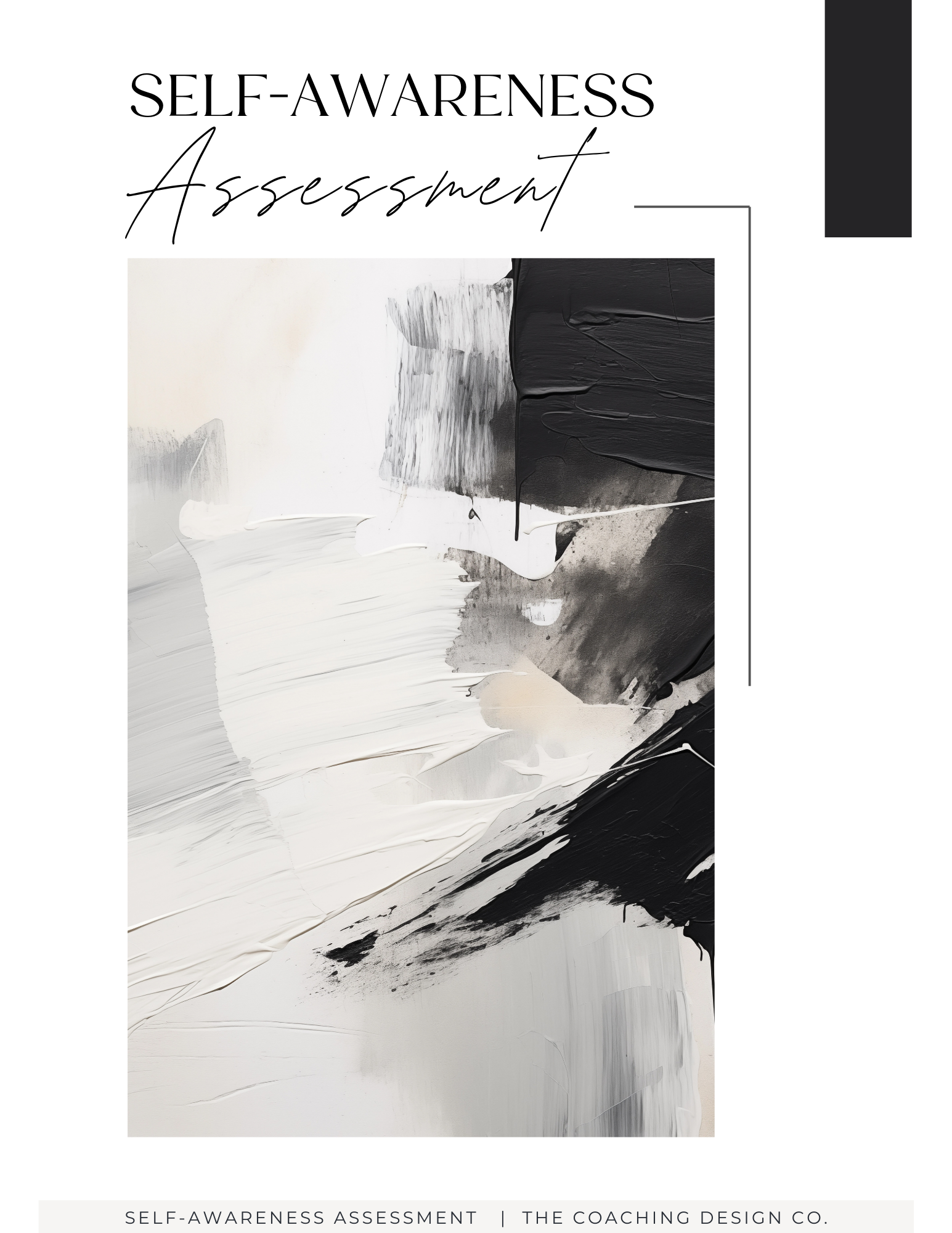
If you are a coach looking for a baseline tool to use with your clients, or an individual who wants to go deeper in your personal growth process, download our custom-designed self-awareness assessment, which is a comprehensive 20-page digital download designed for both coaches who are looking for client assessments, and for individuals who are committed to personal growth. This dynamic resource provides a structured yet flexible approach to self-discovery, offering a robust toolkit to enhance self-awareness.
Please note: This is a digital download, formatted as an 8.5×11 fillable pdf. No physical items will be shipped to you.
Key Features:
Self-Awareness Rating Scale: Assess your self-awareness with a carefully crafted rating scale, allowing you to assess various facets of your personality, emotions, and behaviors.
Questions for Reflection: Dive deep into introspection with thought-provoking questions designed to uncover hidden insights and foster a profound understanding of your motivations and aspirations.
Journal Prompts: Encouraging self-expression, the assessment includes journal prompts to guide you through the process of recording your thoughts, emotions, and personal growth journey.
Guidelines for an Informal 360 Review: Unlock the power of diverse perspectives with step-by-step guidelines on conducting an informal 360 review.
Questions for Informal 360 Review: Facilitate meaningful conversations with colleagues, friends, or mentors using targeted questions to gather constructive feedback and gain valuable external insights.
Action Planning Templates: After reflection and 360 feedback, it’s time to build an action plan to move toward the most meaningful goals. Three action planning sheets are included with thoughtful prompts and questions.
Inspiring Quote Pages: Stay motivated and focused on your self-awareness journey with pages featuring printable quote pages that resonate with the themes of introspection, growth, and authenticity.
Book Recommendations: Strengthen your self-awareness toolkit with carefully curated book recommendations, handpicked to further enrich your understanding of yourself and propel your personal development.
Whether you are a coach guiding clients toward self-discovery or an individual on a solo journey of introspection, our Self-Awareness Assessment will help you to accelerate the process, unlocking the keys to greater self-awareness, resilience, and personal fulfillment.
Step 1: Rate Your Self-Awareness
Despite how valuable it is, we can be easily deceived into thinking our self-awareness is higher than it is. Various research studies demonstrate that although the vast majority of people consider themselves to be self-aware, only a small percentage truly possess accurate self-understanding.
Without pausing for honest, thoughtful self-reflection, we may hold onto a fuzzy, idealistic self-assessment that is either unclear, inaccurate, or both.
—> Get clearer about your level of self-awareness with my comprehensive self-awareness assessment. This is a 20-page digital download and includes a self-awareness rating scale, questions for reflection, journal prompts, guidelines to complete an informal 360 review, questions to ask in your informal 360 review, and inspiring quotes to keep you motivated in the journey.
Step 2: Build a Rhythm of Reflection.
Focused reflection times can help us build strong internal self-awareness, which Eurich describes as one part of the self-awareness equation. Internal self-awareness is the degree to which we have clear understanding of the most important attributes of our identity, our goals and aspirations, how we relate and respond to our environment, and how we influence others.
Intentional introspection can lead us to greater self-understanding — when we ask the right types of questions with curiosity and consistency. Instead of asking “why” questions, which can mislead us or trigger defensiveness, questions that begin with “what” or “how” are more productive and future-focused.
Consider using these questions as part of your own rhythm of reflection — a regular time in which you seek to refine your internal self-awareness:
What are your core values? In which areas of your life are your values conflicted?
What are your most important passions? In what ways are you investing in those passions?
What are your future goals? What steps are you taking towards those goals?
Within your current work or life season, how fulfilling is your “fit”? Are you in a place that supports your personality, strengths, and values?
How do your thoughts and emotions contribute to healthy (or unhealthy) behaviors?
How do you manage your reactions to life circumstances or to other people?
What impact are you having on others? What impact would you like to have?

Step 3: Create Clarifying Feedback Loops.
The second part of our self-awareness, according to Eurich’s research, is external self-awareness, which is how others perceive us. Seeking feedback is an important step in growing in our external self-awareness. ‘
“Feedback loops are the invisible forces that shape human behavior.”
One of my first leadership mentors explained her commitment to create feedback loops as an effort to align her values with behaviors. She asked her spouse and kids these two simple questions every week:
“How I’m doing?”
“What can I do differently to be a better (mom / spouse)?”
Her first question is a valuable check-in question, to see what impact she is having on her most important people. And her second question is asked in a “feedforward” format — a feedback strategy recommended by author Joe Hirsch in which we seek future-focused, actionable feedback rather than analyzing and dwelling on flaws from the past.
Simple, yet intentional questions like these — asked to the people who care about us and will give us honest answers — can reveal valuable insights that motivate us to grow and change.
Get the Guide to Inspire Intentional Growth
Get the free guide, Growth by Design: A Leader's Guide to Intentional Growth, featuring an assessment to map your growth zone, a set of growth-mindset coaching questions, and the growth sprint method.
You'll also join 3,000+ leaders and coaches who read The Coaching Mindset.