
How Stakeholder-Centered Coaching Turns Feedback Into Leadership Growth
“If you want to lead a learning organization, improving the quality of feedback is job one.”
Imagine you've spent six months working with an executive coach.
You've gained valuable insights into your leadership style, identified habits that aren't serving you well, and developed new strategies for communicating, delegating, and navigating difficult conversations. You feel more confident, intentional, and equipped to lead.
But here's a question worth considering:
Would the people you work with say you've changed?
Perhaps you've been working on becoming a better listener, but your team still experiences you as someone who dominates conversations. Or you've made a commitment to delegate more effectively, yet your direct reports are still waiting for you to make decisions they could handle themselves.
There's an important distinction between recognizing how we need to grow and demonstrating that growth in ways others can experience.
This is where stakeholder-centered coaching offers a valuable perspective on leadership development.
Rather than relying exclusively on a leader's personal insights or self-assessment, stakeholder-centered coaching brings the perspectives of colleagues, supervisors, direct reports, and other key stakeholders into the development process.
The goal isn't simply to gather more feedback (although it is helpful to have that additional perspective). It's to create a collaborative process that helps leaders translate feedback into meaningful, observable changes in how they lead.
As executive coach Marshall Goldsmith and researcher Howard Morgan concluded in their influential article, Leadership Is a Contact Sport:
"The development of leaders, we have concluded, is a contact sport."
That observation captures a central idea of stakeholder-centered coaching: leadership development may begin with personal reflection, but its impact extends into our everyday interactions with others.

What Is Stakeholder-Centered Coaching?
Stakeholder-centered coaching is an approach to leadership development that actively involves people who work with or are affected by a leader's behavior.
Instead of treating coaching as an entirely private process between a coach and client, it creates opportunities for selected stakeholders to offer perspectives that inform development goals, suggest improvements, and provide feedback on observable changes over time.
Executive coach Marshall Goldsmith is widely recognized for developing the formal Stakeholder Centered Coaching methodology, which emphasizes behavioral change and ongoing stakeholder involvement.
In Goldsmith's model, leaders typically receive feedback from colleagues, identify specific behaviors they want to improve, invite stakeholders to offer suggestions, and follow up regularly to assess whether their efforts are making a difference.
The underlying principle is both simple and challenging:
If leadership effectiveness is experienced through our relationships with others, those relationships can also help us evaluate and strengthen our leadership.
Consider a leader who wants to improve their communication.
They might believe their primary challenge is becoming more concise. But feedback from colleagues could reveal that the larger concern is something different: they frequently change priorities without explaining why, leaving team members uncertain about expectations.
Without those outside perspectives, the leader might spend months developing a communication skill that doesn't fully address the problem others are experiencing.
Stakeholder feedback helps connect development goals to actual leadership interactions.
How Feedback Becomes a Catalyst for Leadership Growth
Most leadership development programs recognize the importance of feedback.
Organizations invest in 360-degree assessments, performance reviews, and leadership evaluations, often with the expectation that greater awareness will lead to better leadership.
But research suggests the relationship between feedback and improvement is more complicated.
In a 2005 research study published in Personnel Psychology, researchers Smither and colleagues examined 24 longitudinal studies of multisource feedback.
They found that improvements in ratings from supervisors, peers, and direct reports over time were generally small.
This doesn't mean feedback is ineffective. Rather, it challenges the assumption that providing someone with information about their performance will automatically lead to meaningful improvement.
Another influential study by Avraham Kluger and Angelo DeNisi found that although feedback improved performance on average, more than one-third of the feedback interventions examined were associated with decreased performance.
The researchers suggested that feedback can influence where people direct their attention. When feedback helps individuals focus on learning and improving a task, it can be productive. When it redirects attention toward concerns about the self, it may interfere with performance.
Think about the difference between hearing:
"You aren't a good communicator."
And:
"When priorities change without an explanation, team members struggle to determine what to focus on next."
The first feels like a judgment about someone's competence. The second describes a specific behavior and its consequences, creating an opportunity to explore what could be done differently.
This distinction matters because feedback is most useful when leaders can translate it into actionable behaviors rather than treating it as a verdict on who they are.
The Follow-Up Factor
One of the most compelling studies supporting ongoing stakeholder involvement comes from Marshall Goldsmith and Howard Morgan.
In their 2004 article, Leadership Is a Contact Sport: The Follow-up Factor in Management Development, they examined leadership development programs across eight major corporations.
The analysis included more than 86,000 survey responses related to 11,480 managers.
Although the organizations used different development approaches, the researchers found an important pattern: leaders who consistently followed up with colleagues about their development were more likely to be perceived as improving their leadership effectiveness.
Leaders who did little or no follow-up were considerably less likely to receive favorable improvement ratings.
The researchers concluded:
"The development of leaders, we have concluded, is a contact sport."
The findings suggest that leadership development may depend not only on what happens during a coaching session or training program, but also on what leaders do between those formal development experiences.
The findings raise an interesting question:
What if one of the most valuable things a leader can do after receiving feedback is to keep the conversation going?
Rather than viewing feedback as a report to review and file away, stakeholder-centered coaching treats it as the beginning of an ongoing developmental conversation.

How Does Stakeholder-Centered Coaching Work?
The specifics vary depending on the coaching engagement, but a stakeholder-informed process generally involves five interconnected practices.
1. Identify the people who experience your leadership
The first step is determining whose perspectives would be most valuable.
Depending on the leader's role and development goals, stakeholders might include direct reports, peers, supervisors, senior leaders, or colleagues from other departments.
The objective isn't to gather feedback from as many people as possible. It's to identify individuals who regularly observe the behaviors the leader wants to develop.
For example, if a leader is working on executive presence, senior colleagues who observe their participation in strategic meetings may offer helpful perspectives.
If the goal is strengthening delegation, direct reports may provide more useful insights.
2. Select the right feedback method
The next step is selecting the most effective way to gather stakeholder feedback. The right approach depends on the leader's development goals, organizational context, and the type of insight needed to guide their growth.
Several approaches can be effective:
360-degree assessments: Structured questionnaires that gather ratings from supervisors, peers, direct reports, and sometimes other stakeholders. These can reveal patterns across leadership competencies and differences between self-perception and others' experiences.
Stakeholder interviews: Individual conversations conducted by the coach to explore how colleagues experience the leader's strengths, challenges, and opportunities for growth. Interviews can uncover important nuances that standardized assessments might miss.
Customized feedback surveys: Short questionnaires designed around specific development priorities, such as communication, delegation, or collaboration.
Direct feedback conversations: Structured discussions in which leaders invite stakeholders to share observations and suggestions, sometimes with guidance from their coach.
Each method provides a different kind of insight. A 360-degree assessment can offer a broad view of leadership effectiveness, while interviews may provide a deeper understanding of the behaviors and circumstances behind stakeholder perceptions.
3.Translate feedback into focused development goals
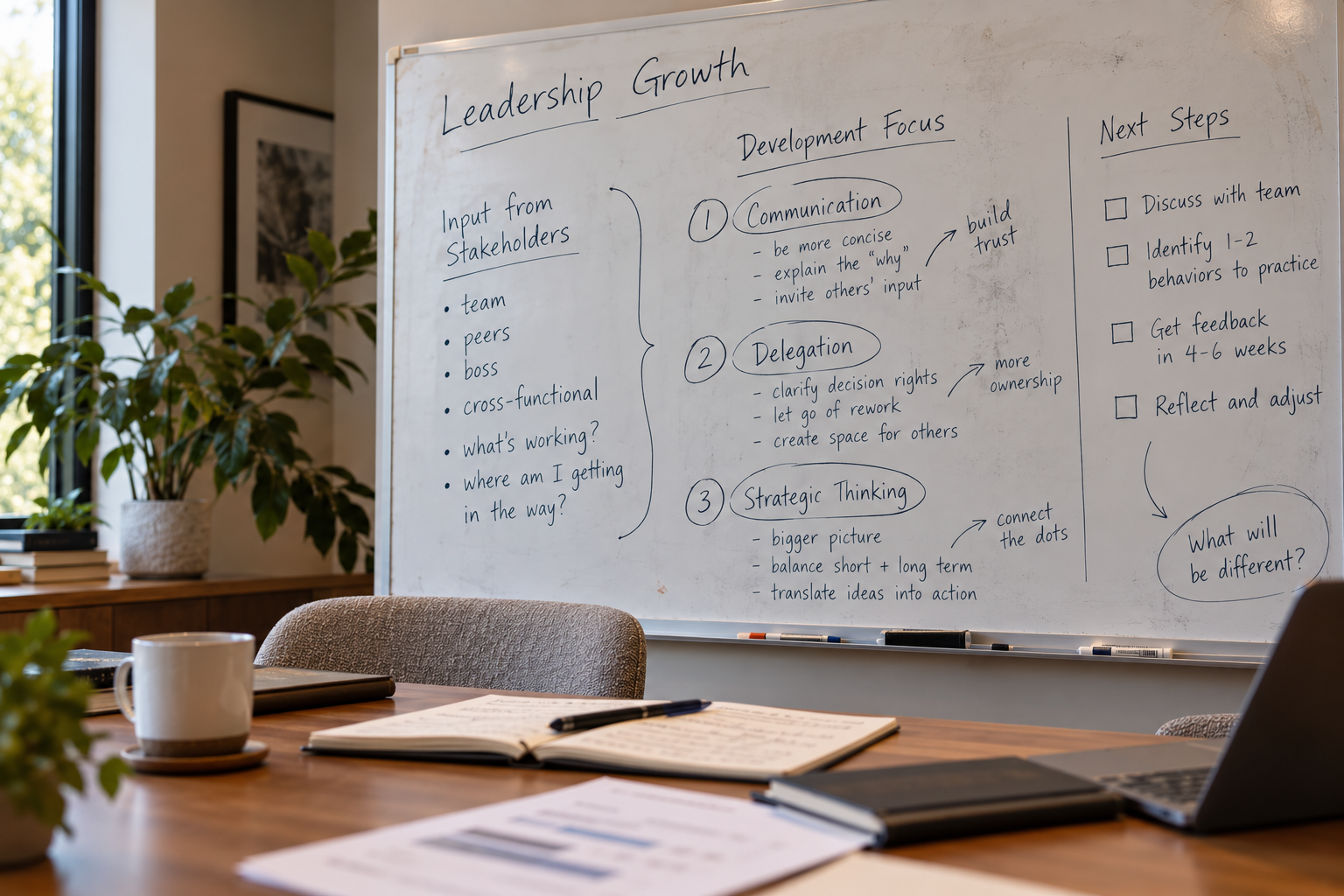
Once stakeholder feedback has been collected, the coach and client look for patterns, differences in perspective, and opportunities for growth. Together, they translate these insights into specific leadership behaviors the client can begin practicing.
This requires more than identifying the lowest scores or most frequently mentioned concerns. Feedback must be interpreted in context, considering the leader's responsibilities, strengths, organizational environment, and desired outcomes.
A useful development goal describes a behavior the leader can practice and stakeholders can reasonably observe.
| Broad Development Goal | Observable Leadership Behavior |
|---|---|
| Improve communication | Explain the rationale behind priority changes. |
| Become a better listener | Invite others' perspectives before offering recommendations. |
| Delegate more effectively | Clarify decision authority and avoid unnecessary intervention. |
| Build trust | Follow through on commitments and communicate changes. |
| Strengthen collaboration | Involve colleagues earlier in cross-functional decisions. |
This emphasis on specific behaviors is consistent with Locke and Latham's research on goal setting, which demonstrates the value of specific, appropriately challenging goals.
4. Invite stakeholders to become development partners
As leaders begin practicing new behaviors, they can invite stakeholders to become ongoing development partners by sharing suggestions, observations, and encouragement.
Rather than treating stakeholders exclusively as evaluators, leaders invite them to contribute ideas for improvement.
For example, a leader working on delegation might ask:
"What is one thing I could do differently that would help you feel more ownership over your work?"
Goldsmith describes a related practice called feedforward, which encourages stakeholders to offer suggestions for future improvement rather than concentrating exclusively on past mistakes.
Stakeholders may have different preferences, expectations, or priorities, so leaders shouldn't assume every suggestion must be implemented. Coaching helps them thoughtfully evaluate feedback and select meaningful changes.
5. Experiment with new leadership behaviors
Leadership development doesn't occur only through reflection. It happens when leaders apply what they're learning.
Consider someone who wants to delegate more effectively.
During coaching, they might discover that their difficulty delegating comes from an underlying concern about mistakes or a reluctance to relinquish control.
Understanding those patterns is valuable, but now the leader needs opportunities to behave differently.
They might intentionally practice clarifying expectations, giving team members greater decision-making authority, and resisting the urge to intervene prematurely.
Their next coaching conversation becomes an opportunity to reflect on what happened, identify what worked, and refine the approach.
6. Follow up to make progress visible
A leader might believe they've made tremendous progress in listening more attentively, but their colleagues may have noticed only a small difference.
Alternatively, stakeholders might recognize meaningful improvements the leader has overlooked.
Both possibilities provide useful information.
Follow-up can involve brief conversations, structured check-ins, repeat interviews, or short surveys tailored to the leader's development goals.
The objective isn't to achieve universal approval. It's to understand whether the leader's efforts are producing the intended changes and where further growth is needed.
Depending on the feedback method used at the beginning of the engagement, the coach and client may also revisit selected assessment questions or stakeholder interview themes to evaluate changes over time.
When feedback becomes an ongoing conversation instead of a one-time event, leadership development becomes easier to observe, discuss, and refine.
What Does Stakeholder-Centered Coaching Look Like in Practice?
Consider a hypothetical example.
A newly promoted director begins executive coaching after receiving feedback that their team is struggling with unclear expectations and inconsistent communication.
The director believes the primary challenge is the team's difficulty adapting to change.
As part of the coaching engagement, the director invites feedback from their supervisor, several direct reports, and a cross-functional colleague.
Three themes emerge:
Clarity: Team members understand the department's priorities but aren't always sure how individual decisions connect to them.
Decision-making: Employees feel comfortable offering ideas but frequently wait for the director's approval.
Communication: The director communicates often, but the reasons behind changing decisions aren't always clear.
The feedback reveals something important.
The director doesn't necessarily need to communicate more. They need to communicate differently.
Together, the coach and client identify two behavioral priorities: explaining the reasoning behind significant decisions and clarifying decision-making authority.
Over the following months, the director experiments with new strategies and periodically asks stakeholders what they're noticing.
Some colleagues report greater clarity. Others still experience hesitation around decisions that cross departmental boundaries.
That feedback helps the director identify the next area to refine.
The coaching process has moved beyond identifying the presenting problem to getting more nuanced, contextualized feedback. It has provided an ongoing opportunity to test strategies, learn from real interactions, and adjust.
Sometimes the most important insight comes from discovering that others experience a familiar situation differently than we do.
When Is Stakeholder-Centered Coaching Most Valuable?
Stakeholder participation isn't necessary for every coaching engagement.
Some clients seek coaching to explore career direction, navigate a personal leadership challenge, or clarify decisions that don't require external feedback.
But there are circumstances in which stakeholder involvement can add considerable value.
Organizationally sponsored coaching. When an employer sponsors leadership coaching, stakeholder input can help connect individual development priorities with organizational expectations. Clear agreements are essential to ensure that the coaching relationship remains confidential and development-focused.
Addressing leadership blind spots. Leaders may understand their intentions without fully recognizing how others experience their actions. Stakeholder feedback can illuminate gaps between intention and impact.
Developing interpersonal competencies. Communication, delegation, collaboration, trust-building, and conflict management are all experienced through relationships. Stakeholder perspectives can help leaders evaluate whether changes are noticeable.
Measuring behavioral progress. When coaching focuses on specific leadership competencies, stakeholder observations can complement self-assessment and provide additional evidence of development.
In each situation, participation should be intentional and appropriate to the client's goals.
What about confidentiality?
One reasonable concern about stakeholder-centered coaching is whether involving others compromises the confidentiality that makes coaching valuable.
Leaders need a space to explore frustrations, uncertainties, and difficult decisions without worrying that every conversation will be shared with their employer. Stakeholder involvement should not eliminate that space.
A well-designed coaching engagement establishes expectations about confidentiality, participation, and information sharing before feedback is collected.
For example, organizational sponsors may receive broad updates about agreed development goals or progress without having access to private coaching conversations or specific details.
Feedback collection should also account for workplace dynamics. Employees may hesitate to share candid observations about a supervisor if they fear negative consequences. Confidential interviews or aggregated feedback may sometimes be more appropriate than direct conversations.
Frequently Asked Questions
-
No. A 360-degree assessment typically gathers perspectives about a leader at a particular point in time. Stakeholder-centered coaching may incorporate 360-degree feedback, but extends beyond assessment through development goals, behavioral practice, ongoing stakeholder input, and follow-up.
-
Participants may include supervisors, peers, direct reports, or cross-functional colleagues. The appropriate stakeholders depend on the leader's development goals and who regularly observes the behaviors being developed.
-
Yes, when appropriate expectations and agreements are established. Stakeholders can contribute developmental feedback without having access to private coaching conversations. Clear agreements should establish how feedback will be collected and what information may be shared.
-
Progress can be evaluated through follow-up interviews, brief surveys, structured feedback conversations, repeat assessments, and observations of specific leadership behaviors. These perspectives can complement the leader's own evaluation of progress.
Closing the Feedback Loop: From Insight to Leadership Growth
Think back to the leader we imagined at the beginning of this article. Six months of coaching have brought greater clarity, confidence, and self-awareness.
But has anything changed for the people who work with them?
That question is at the heart of stakeholder-centered coaching.
Feedback helps leaders understand how they're experienced by others. Coaching provides the space to interpret those insights, explore underlying patterns, and experiment with new approaches. Ongoing stakeholder involvement helps leaders recognize whether their efforts are making a meaningful difference.
And perhaps most importantly, it keeps leadership development connected to the relationships and responsibilities where growth actually matters.
The most valuable feedback isn't necessarily the insight that surprises us during an assessment debrief. It may be the observation someone shares three months later, when they recognize that we're approaching a familiar situation differently.
That's the opportunity stakeholder-centered coaching creates: turning feedback into an ongoing process of learning, practicing, and growing as a leader.
At The Leadership Coaching Lab, I design individualized executive coaching partnerships around the competencies, challenges, and goals that matter most to each client.
When coaching is sponsored by an organization, or when a client wants additional perspectives on their leadership effectiveness, I can incorporate stakeholder feedback into the development process.
Explore Executive & Leadership Coaching and schedule a complimentary consultation to discuss your leadership development goals.
Or schedule a free consultation and tell me a little about your leadership development needs. We can talk through what's happening, what you'd like to accomplish, and which approach might be the best fit.

Dr. Bethany Peters is a Professional Certified Coach (PCC) and leadership expert who helps individuals, teams, and organizations grow through leadership coaching, executive development, team facilitation, and evidence-based assessments. Whether she's coaching one-on-one or leading a workshop, Bethany creates practical, engaging experiences that help people communicate better, lead with confidence, and create lasting change.