
5 Types of Journaling When You Don't Know Where to Start

I can shake off everything as I write; my sorrows disappear, my courage is reborn.
—- Anne Frank
You know journaling could help—you've read the research, heard the recommendations from colleagues and coaches, maybe even bought a beautiful journal with every intention of using it.
But when you sit down with that blank page, nothing comes. The cursor blinks. The pressure builds.
What are you supposed to write about? How do you even start?
Maybe you've tried before. You wrote a few entries about your day, chronicling meetings and tasks, but it felt pointless—like documenting rather than processing. Or you attempted stream-of-consciousness morning pages but found yourself rambling without direction.
If you're a leader or professional, the challenge isn't just what to write—it's when to write and why it matters when you're already stretched thin. You're managing teams, making decisions with incomplete information, navigating conflicts, and carrying the weight of others' expectations. Finding 15 minutes to sit with your thoughts can feel impossible, let alone indulgent.
But here's what the research shows:
Leaders who journal regularly make better decisions, manage stress more effectively, and develop stronger self-awareness.
Yet here’s the paradox: we're told journaling is simple—”just write”—but that vagueness is often what makes it paralyzing for many of us. Without structure, you are more likely to sit down to a blank page and freeze.
But when you approach journaling as a toolkit for thinking—with distinct methods, each designed for a specific purpose—the decision becomes clearer. You're not wondering what to write. You're choosing which self-reflection tool your situation needs.
In the previous post on the neuroscience of journaling, we explored how expressive writing physically changes your brain—quieting the amygdala, engaging the prefrontal cortex, and freeing cognitive resources.
The research is compelling. But knowing why journaling works doesn't solve the practical challenge of how to begin.
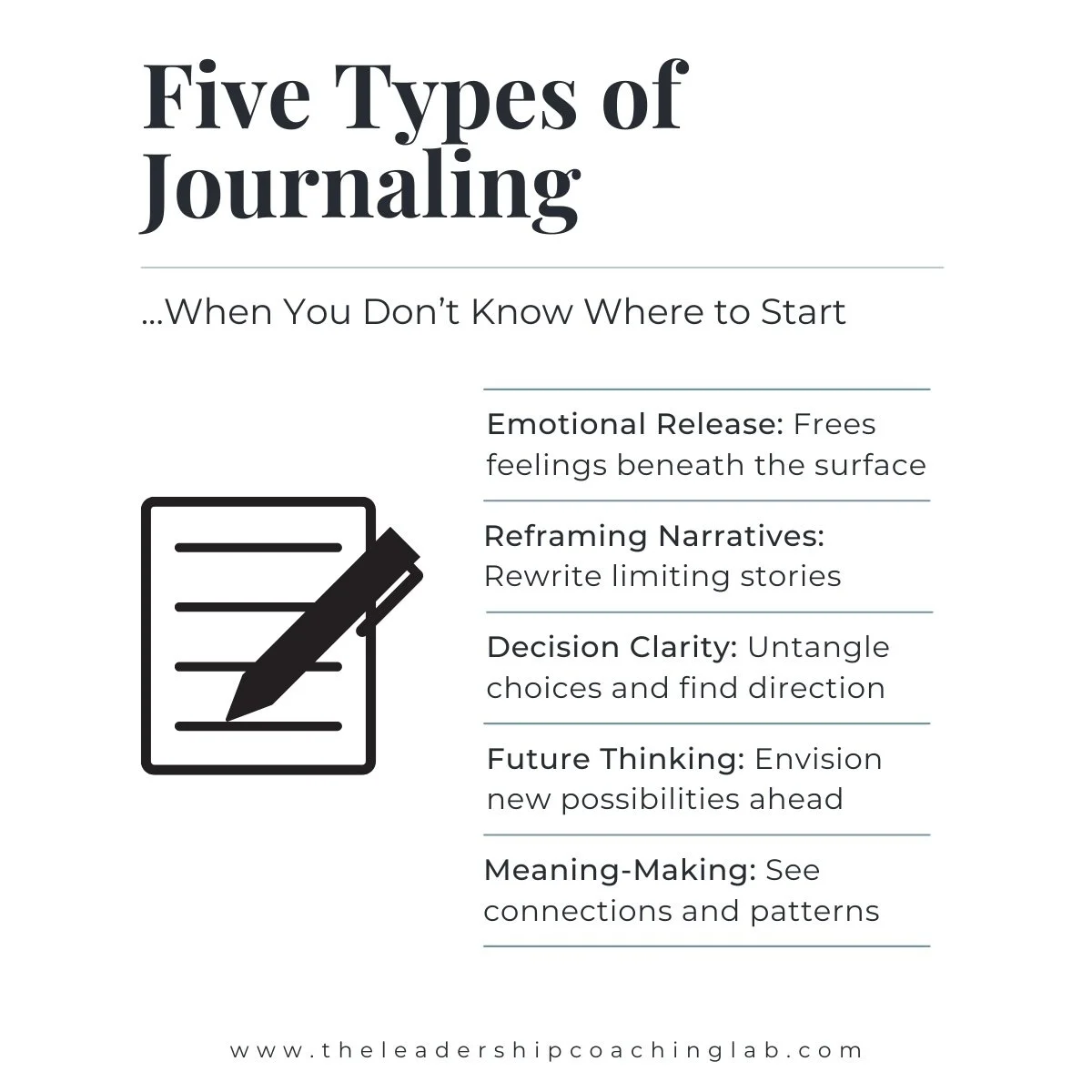
The five journaling approaches below are tools you can reach for depending on what you're facing—whether that's a difficult team dynamic, a strategic decision, or simply the need to process a challenging day. Think of them as different lenses, each one helping you see and process your experience in a distinct way.
Type 1: Emotional Processing / Venting
Purpose: Create enough calm to think clearly.
Sometimes you don't need analysis or strategy. You need to release the intensity swirling in your mind—the frustration after a difficult conversation, the anxiety before a high-stakes presentation, or the overwhelm of competing demands. Venting journaling is about emptying the noise onto the page so it stops consuming mental bandwidth.
Think of this as strategic release. When emotions run high, your amygdala overrides rational thought. By naming what you're feeling with specificity—not just "stressed" but "anxious that I'll be judged" or "furious that my input was dismissed"—you activate the brain's calming mechanisms. The simple act of labeling emotions reduces their intensity.
As a leader, you might find this most helpful after delivering tough feedback, navigating team conflicts, or processing your reaction to unexpected setbacks. After a difficult board meeting or when second-guessing a major decision, venting journaling helps you process your emotional response before it affects how you show up the next day.
When to use venting journaling:
You feel emotionally flooded and can't think straight
You're stuck in a mental loop, replaying the same scenario
You need to process something before you can move forward
You're carrying tension that's blocking your focus
How it works: Write continuously without editing, filtering, or organizing. Let the thoughts pour out exactly as they arise. Don't worry about grammar, logic, or whether it makes sense. The goal is externalizing internal chaos so you can create distance from it.
Use super simple prompts like these to guide you:
What feels most challenging right now?
What mix of emotions am I feeling?
Where do I most need clarity?
The shift you're looking for: You know venting has done its work when you feel the intensity decrease. Your breathing slows. The thoughts stop racing. You've created enough space to access your prefrontal cortex again. From here, you can think more clearly about what comes next.
Key Reflection:
What emotion am I carrying right now that needs to be named and released before I can think clearly?
Type 2: Narrative Reframing
Purpose: Loosen rigid thinking and reduce self-criticism.
We tell ourselves stories about our experiences continuously—why something happened, what it means about us, what others were thinking. These hidden narratives often are unfolding behind the scenes, shaping our emotions and responses. But sometimes the stories we tell are incomplete, or locked into one rigid interpretation, distorted by anxiety or self-criticism.
Narrative reframing journaling invites you to examine the story you're telling yourself and explore alternative interpretations. It's not about denying reality or pretending everything is fine. It's about recognizing that your first interpretation isn't the only valid one—and that other perspectives might be more accurate or helpful.
Leaders especially benefit from this approach when facing setbacks or criticism. The narrative you tell yourself about a failed project, difficult feedback, or team conflict shapes your confidence and your next moves.
Reframing helps you find the learning without staying stuck in self-blame or defensiveness.
When to use narrative reframing journaling:
You're stuck in self-blame or harsh self-criticism
You're interpreting someone's behavior in the most negative way possible
You feel like a failure after a setback
You're defending your perspective rigidly and feeling defensive
You're catastrophizing about future outcomes
How it works: Begin by writing out the story you're currently telling yourself—the unedited version. Then challenge it:
What evidence do I have for this interpretation?
What evidence contradicts it?
What's another way to view this situation?
What would someone who cares about me say about this?
What might I be missing or not considering?
How might this look in six months or a year?
The shift you're looking for: Narrative reframing doesn't require you to arrive at certainty or to convince yourself of a different story. The goal is simply to loosen your grip on the original interpretation—to create enough flexibility to see other possibilities. Increased flexibility reduces emotional intensity and opens space for more balanced thinking.
Key Reflection:
What story am I telling myself that might not be the complete picture?

I write entirely to find out what I'm thinking, what I'm looking at, what I see and what it means. What I want and what I fear.
— Joan Didion
Type 3: Decision-Clarifying
Purpose: Move from uncertain indecision to intentional action.
You have a decision to make. Maybe it's about your career direction, a difficult conversation you need to have, how to allocate your limited time, or which opportunity to pursue. You've thought about it extensively, but the mental loop hasn't produced clarity—only more rumination and second-guessing.
Decision-clarifying journaling helps you work through options systematically. By writing out your thoughts, you force yourself to articulate assumptions that might otherwise remain vague. You examine tradeoffs, identify what you're most concerned about, and notice patterns in how you're framing the choice.
This journaling method can be very powerful when you’re facing strategic, but very complex decisions—whether to restructure a team, pursue a new direction, or how to address performance issues. The written format forces clarity that internal rumination alone rarely achieves. This type of journaling transforms abstract worries into concrete analysis.
When to use decision-clarifying journaling:
You're stuck between multiple options and can't decide
You keep circling the same decision without making progress
You need to separate what you should do from what you want to do
You're avoiding a choice because the implications feel overwhelming
How it works: Start by naming the decision clearly. Then work through these elements:
What are the options you're considering?
What are the pros and cons of each option?
What assumptions are you making about each choice?
What's the worst-case scenario for each path?
What does each option require of you?
Which choice aligns most closely with your values?
What would you advise a colleague facing this decision?
The shift you're looking for: This journaling technique doesn't always produce one obvious answer. Sometimes it reveals that you're ready to choose but have been avoiding a commitment. Other times it uncovers a third option you hadn't considered. The goal is to move from paralysis to intentional action—even if that action is deciding to wait and gather more information.
Key Reflection:
If I trusted myself fully, which direction would I move toward?
Type 4: Meaning-Making
Purpose: Turn experience into insight and growth.
You've been through something significant—a difficult project, a career transition, a confusing conflict, or a noteworthy success. The experience is over, but you haven't fully processed what it meant or what you learned from it. Meaning-making journaling helps you integrate the experience so it becomes part of your growth rather than something that simply happened.
This type of journaling is reflective and often done with a little bit of distance from the event itself. The focus here is gaining insight and wisdom, though emotion may certainly surface as you write. What did this experience teach you? How did it shape you? What patterns or themes do you notice? How does this fit into your values or identity?
After completing a major project, navigating a difficult transition, or experiencing a significant leadership challenge, meaning-making journaling helps you extract the lessons and integrate them into your leadership philosophy. This is how experience becomes wisdom rather than just history.
When to use meaning-making journaling:
You've completed a significant experience but haven't reflected on it
You want to gain greater learning from an important experience
You're noticing patterns across multiple experiences
You're trying to understand how you've changed or grown
You want to honor an experience by finding its significance
How it works: Start by recounting the experience briefly—not every detail, but the core elements. Then shift to reflection:
What was most challenging about this experience?
What surprised me?
What did I learn about myself?
How did I show up? What do I appreciate about how I handled it?
What would I do differently next time?
How does this experience connect to my values or sense of purpose?
What insight or shift came from this?
The shift you're looking for: Meaning-making journaling transforms raw experience into integrated wisdom. You're no longer carrying the experience as something unresolved. You've found its place in your story. Often, this process reveals growth you hadn't fully acknowledged—you handled something difficult, you stayed true to your values, you learned something essential.
Key Reflection:
How have I grown from this in ways I might not have realized yet?
Type 5: Visioning / Possibility Thinking
Purpose: Expand your thinking into future possibilities.
When you're facing a transition, feeling stuck in your current role, or sensing that something needs to shift, you need space to imagine without the pressure to decide. Visioning journaling creates that space.
It's exploratory, playful, and expansive rather than analytical.
You're allowing yourself to consider possibilities you might have dismissed too quickly, to explore identities or directions that feel risky, to articulate desires that aren't fully formed yet. The key is removing the burden of commitment—you're not making promises or locking yourself into anything. You're simply exploring.
When contemplating a career transition, considering your leadership legacy, or reimagining your role, visioning journaling creates space to explore without the pressure to decide immediately. You may want to try this type of journaling when you are feeling restless in your current position but unsure of the alternatives.
When to use visioning journaling:
You feel restless or disconnected from your current path
You're in a transition and unsure what comes next
You've been focused on problems and need to reconnect with possibility
You want to explore a change but feel paralyzed by the implications
You need to dream before you strategize
How it works: Give yourself permission to imagine freely without justifying, explaining, or defending your thoughts. Write as if you're brainstorming—no idea is too impractical, too ambitious, or too small. Explore questions like:
What would I do if I weren't afraid?
What energizes me most right now?
What would my ideal day/week/year look like?
If I could design my role from scratch, what would I include?
What skills or experiences do I want to develop?
What kind of impact do I want to have?
The shift you're looking for: Visioning journaling often surfaces themes or patterns you hadn't noticed before. You might discover that several different possibilities share a common thread—for example, maybe you’re noticing a desire for greater autonomy, creativity, connection, or stability. Those themes become clues about what truly matters to you, even if the specific vision shifts over time.
Key Reflection:
What would become possible if I gave myself permission to explore without committing?
Your Next Step
If you've never journaled consistently, start with just one approach. Try venting journaling after a difficult day. Experiment with decision-clarifying when you're stuck.
Notice what happens when you give yourself permission to simply write without judgment or performance.
Journaling gains its power through consistent practice—showing up for yourself repeatedly, creating space to think, feel, and grow with intention.
Which journaling approach will you try first?

Get the Guide to Inspire Intentional Growth
Get the free guide, Growth by Design: A Leader's Guide to Intentional Growth, featuring an assessment to map your growth zone, a set of growth-mindset coaching questions, and the growth sprint method.
You'll also join 3,000+ leaders and coaches who read The Coaching Mindset.